Showing posts with label feminism. Show all posts

Monday, October 1, 2018

Your Gender Politics Cannot End at the Wings: Seeing Richard III at Seattle Shakes

Sarah Harlett as Richard III and Suzanne Bouchard as Buckingham. Photo by HMMM Productions

Last night I went to see Richard III at Seattle Shakes, produced in partnership with upstart crow collective. Last year I saw Part 1 of Bring Down the Housewhich enthralled me, as it did most of Seattle. At the time, my concerns over representation on creative teams was nascent and not fully formed. So forgive me for not having written about this before.

From upstart crow's website:

upstart crow collective was co-founded by Betsy Schwartz, Kate Wisniewski and Rosa Joshi in 2006. We are dedicated to producing classical works with all-female casts for contemporary audiences. Focused on telling story and living characters honestly on stage, our work is text centered and visually imaginative.

What an amazing, admirable mission. Really inspiring for me (user of she/her and they/them pronouns) to read and then absorb their work. Shakespeare has always felt too elite, too wordy, too distant for me. Even when I've designed for Shakespeare, the dated gender politics frustrate me, especially when I'm responsible for clothing the female-identified characters -- often in modern dress -- to fit in with the tropes of womanhood: virgin, mother, whore. So to get the opportunity to take in the power and politics of the histories told by some of the most formidable performers in the area who would not otherwise get to play these lords and princes and kings: awe.

And then I look the production team page.

And my heart sinks.

First, let me be clear that I admire and respect every single designer who worked on this production and really loved their choices and designs. This is not commentary on what was represented on stage by their artistic vision. I also recognized that the same creative team worked on Richard III also designed for Bring Down the House. And that there is great comfort in not having to re-establish visual language and vocabulary when taking on adaptive work that is risky (yes, all female-presenting performers doing Shakespeare will probably always be risky even if you've proven it's amazing).

However... why is the design team still a representation of our male-dominated theatre field? Set designer, lighting designer, co-sound designer.... all  male-presenting if not -identifying designers. Costumes, props, and co-sound designer are holding down the other part of the identity pool, but that's pretty normal for our industry. Check out this HowlRound report from 2015 if you'd like statistics to back this up.

Yes, this frustration about the utter lack of representation at the creative table comes from a selfish place. Let's just get that out there. I see my male-counterparts get asked time and again to do scenic designs and I look at my resume--MFA, Award-winning Designs, GENERAL AWESOMENESS--and ask why not me? And then I get the call to design costumes for that same show and I'm like, cool, my chromosomes dictate where my skill lies.

But this goes beyond me. And gender. While it's easy to be frustrated that theatre, as a field, is lead by cis-het white dudes when you're definitely not checking many boxes in that identity, it's even more angering that, in the name of equity, diversity, and inclusion (EDI) as well as novelty and marketing buzz, theatres are mounting these amazing productions that examine how stories can change, grow, and deepen when the bodies presenting them (aka performers) are as diverse as the population in 2018.

And that is really important.

However, the people who are creating the world of these gender-swapped, racially diverse stories ALSO have to be a part of the under-represented groups. The voices around the table making decisions about architectural angles, ephemeral lighting, and subconscious-gripping sound cannot continue to be (cis-het, white) men if we're truly going to end white supremacy and patriarchal control of our art form.

I look at the production team of Richard III, and my first frustration comes from the male-domination in those creative roles. And then I look on stage and see the choice of director Rosa Joshi to pit the transcendent Porsche Shaw as Richmond, savior of England, against the gripping, equally-talented Sarah Harlett as Richard III, twisted monarch, and I cannot help but see (and feel) the politics of 2018: a Black leader (dressed in white, shout out to the costume designer) standing above the slain White leader (still dressed in black), declaring victory and peace for England.

The conversation expands, knowing full well that the racial and cultural identities represented on that list of creatives are dominated with whiteness.

The set design, along with lighting and sound, create the container of the production. It sets the tone, the visual language, and the boundaries of the world that the story exists in. When producers and producing companies do not consider who is making those decisions -- sure, to be molded by a director who often does sit at the intersection of multiple marginalized identities, but damn that's a lot of burden for one artist to bear -- they are continuing to bound the story by cis-het white male privilege and thinking (and art). It's hidden to the audience, the donors, the media. But not to the performers and the members of the creative community. We see this inequity, we can feel the oppression of decisions that impact our identities (in June 2018, American Theatre Magazine published an article that discussed how the white-gaze plays out in lighting design -- where designers have to light all skin tones).

If we are going to turn a corner as an artistic pursuit, our equity and inclusion politics cannot stop at the wings. We need to infuse our creative teams -- and our admin teams -- with the voices of everyone who resides in our universe in 2018, but specifically with the ones that we haven't been hearing or listening to.

I want to be hired. But more importantly, I want to see the world through intersectional eyes.

Friday, September 15, 2017

Designer's Notebook: Why We Have A Body at Strawberry Theatre Workshop

Mahria Zook as Renee and Alyssa Keene as Lili.
Photo by John Ulman.
Last night I opened my sixth show of 2017: Why We Have a Body by Claire Chafee at Strawberry Theatre Workshop here in Seattle. I was brought onto this project about seven weeks ago in a hurried conversation with director Rhonda J Soikowski who reached out to me on the recommendation of one of her colleagues. Rhonda pitched the show -- a four-hander that explores the role of gender, sexuality, mental illness, and family and was a sensation in the 1990s. Immediately images of pleated pants and shoulder pads flashed through my head.

Just a month before this call, I had made a decision to be more picky about the shows that I take on. My more stringent criteria was not about pay or working conditions but about the mission of the organization and/or the voices that would be amplified by the project. Coming off of one big musical with over 80% white or white-passing actors in the cast into a three-hander with an all-white cast and creative team, and then going into production managing and designing for Sound Theatre Company's Hoodoo Love by Katori Hall, there was a light bulb that went off in my head. I could only give my energy and life-blood (which is what we freelancer do give) to companies and shows that put their money where their mouth was and elevated under-represented and vulnerable voices in order to disrupt the white supremacy we are all now too familiar with in Trump's America. (Yes, duh.)

Rhonda's call and request for me to squeeze Chafee's non-linear, monologue-filled examination of women writing their own definition and future in a patriarchal world was my first test of my conviction. I had planned August to be a month of recuperation and preparation for the last of my 2017 shows. And yet, this was not a case of not being able to say no, which I definitely am afflicted by. This show was calling to me.

Back in my Feminist Theatre class in grad school at UNC Greensboro, I wrote a paper called "Becoming a Feminist Designer: Troubling the Traditions of Design." In the paper, I dissected traditional theatre design techniques and pedagogy using a third-wave feminist framework. It was the beginning of putting into words something I had long felt in my bones: my identity is imprinted on my designs and adds (positive and/or negative) value to them. And, by that logic, so does the identity of any designer. Thus, who is designing a production is as important as who is directing it, who is acting in it, and what it is about.

But I was only scratching the surface, struggling to apply inadequate language and theory to something much, much bigger than this.

Enter intersectionality.

Coined by civil rights activist KimberlĂ© Williams Crenshaw in 1989 essay, intersectionality is the complex, cumulative manner in which the effects of different forms of discrimination combine, overlap, or intersect. Now, in 2017, intersectionality is being used to expand our understanding of identity, white supremacy, and white privilege.

I have a more indepth write up about what I'm beginning to coin intersectional design practices (instead of feminist design theory), but the gist of it is that, as a designer, you have to interrogate your own position of power and privilege, interrogate the expected audience's, and then, and only then, do you start to break out the design decisions that build the world or clothe the characters. (Again, more later.)

So, back to Why We Have a Body for which I acted as the costume designer.

In Chafee's stage directions, she explicitly calls out various costume needs like Mary's orange coveralls and Eleanor's bib-waders, but it is in her stage directions for Renee, the married paleontologist caught in a love affair with female private investigator Lili, that demands an understanding of gender performance of the 1990s -- because that's when the play was written (and our production was set) -- and that of 2017. While in Mexico, trying to patch things up with her perpetually off-stage husband, Chafee's stage directions read, "She gives a tiny wave. Picks up his wallet, and she picks up his watch and puts it on. She feels its weight on her wrist...feels what it's like to wear a man's watch. She stares out." In that little ellipses, Chafee is telegraphing the subtext of Renee's navigation of her identity just a few scenes after we've heard her say to Lili, "Maybe I'm a man. Is that a possibility? I feel like a man..."

Oh, oh, oh, oh, oh.

I'm not going to do a thorough job unpacking this -- this blog post is not intended to be an academic paper -- but can you see the power of identity, gender performance, and power all wrapped up in the act of a woman wearing a man's watch? Layer onto that the very real trajectory of gender expression in the 1990s LGBTQ+ community, what was fueling Chafee's script, and this costume/prop piece is explicitly emblematic of what each stitch of clothing means in conveying character to drive the narrative as well as bring the audience along on that journey.

This stage direction is an explicit demand of Chafee that particular attention had to be paid to the costumes of these characters. As a cis-gender, heterosexual female, I knew I needed to rely on the authorities in the room to guide me. I had to unpack my privilege and experience to know that while I might think something looks right or is the right price, I am not the authority on that.

On the night of preview, I gave the actress a new watch -- we had been using a personal piece that I didn't want to risk during the show -- and while it fit as a 1990s men's gold watch, on stage it read more as a woman's watch. I saw it that way, from the other side of the audience. But, more importantly, Rhonda (the director), who had told me in my initial phone conversation about the personal connection she has with the play as a "lesbian of a certain age", told me it wasn't right. Because--and this is why intersectional design is more than just applying an understanding of the intersections of oppression and power but is in fact about navigating the intersections of the history of that oppression and power as defined by modern, regional, and generational understanding of our world--what a 2017 audience knows as an undoubtedly "heavily coded masculine" watch (which were the exact notes in a rehearsal report for the watch) is an almost comically large metal watch.

While there were so many other in-depth conversations about the costumes as they pertained to the presentation of each character that I could go into, the story about the watch is the epitome of how design must take into account everyone from the playwright to the director to the audience, and also the designer herself.

It was a such a wonderful opportunity to hone my definition and understanding of the intersectional design process with a play that demands it. I'm grateful that I said yes and I hope that, in my more curated 2018 season, these opportunities will multiply. But I am also excited to start formulating and sharing out this philosophy with the world.

--

See Straw Shop's Why We Have a Body by visiting the brown paper ticket page.


Wednesday, September 28, 2016

Catharsis: The Royale @ ACT


Show: The Royale: A Play in Six Rounds; by Marco Ramirez
Theatre: ACT; Seattle, WA
Tickets: ACT Pass
Date & Time: Sunday, September 26, 2016 @ 2pm

Okay, an important bit of information is that I went to see this play after spending around 24 hours over 4 days taking an ArtEquity intensive. For four days we worked on establishing a basis for understanding and identifying white supremacy, oppression, and inequalities due to gender, race, sexuality (to name a few) in society that have been perpetuated for hundreds of years in our country. It was a very intense experience and to finish it off by watching a play that drives each of those points home was, as my title alludes to, an extremely cathartic experience.

The Royale is inspired by the historical, groundbreaking boxer Jack Johnson who was the first black heavyweight champion from 1908 to 1915. Ramirez's play explores Johnson's story leading up to his first fight against the fictional white heavyweight champion Bernard "The Champ" Bixby. The script deftly runs Johnson's desire to be the best boxer alongside his struggle against racism and Jim Crow Laws, pitting his egoism and selfish lifestyle against his dedication and love of his sister. The play itself is beautiful and cutting at a time when our nation is struggling with extreme violence against men and boys of color. During an interview with press, Johnson tackles the fact that his athleticism and talent are explained away by the fact that "his kind" are prone to violence, so of course he would be drawn to boxing.

But, as is the case with many plays, it is the entire package that makes this a memorable show. Because I follow these things, I was excited to follow the interviews and write ups about director Ameenah Kaplan's approach to the show. Kaplan was part of the original company of STOMP and, per her wikipedia page, has been drumming since age 12. Her relationship with movement and percussion shine through the staging of The Royale. As she says in the interview found in the program, "...rhythm.... It calms, it soothes, and it informs." The rhythmic performance of the script, from the boxing moves to underscoring important lines, most definitely informs the story and pushes this play beyond a simple "based on the life of" and into the realm of immediate, necessary, and heart-rending.

I also must comment on Carey Wong's beautiful set. If you know anything about my own aesthetic, it will come as no surprise how much I believe that the bare stage of this show with just four stools is exactly what this show needed. The barebones of a boxing ring, the platform allows the story, the words, the people to take precedence over the visual world, which is exactly how scenery should act. It also makes the moment when the boxing ring is created for the final face-off of Johnson that much more powerful. The caging of "the grizzly bear" is complete and the audience can't help but be struck by Johnson's courage in the face of societal and personal demons.

But more than the excellence of this production, which ACT rarely disappoints on, is how important it is that this story was chosen for the main stage season of a LORT company. When so many seasons at the leading theatres in Seattle and the country are written and directed by and starring predominately white males, to have a production that celebrates and analyzes the racial injustices of then and now while celebrating talented artists that are often relegated to second string companies is important. My ArtEquity training is showing, but I have been so disappointed by the lack of diverse stories available to my communities by the theatres I work with and/or admire. The day before I attended this performance, I was fortunate enough to attend The Black Women Wisdom Summit, curated by Valerie Curtis-Newton and hosted by The Hansberry Project and Intiman Theatre. During the rich, honest conversation between the 11 black women playwrights and Curtis-Newton, a simple truth of the lack of diverse representation became clear. Dominique Morisseau said it best (and do go read the article/transcript from Seattle Weekly linked above for more pearls of wisdom):

"Whose universe? Saying that work should be 'universal' is code for work that should be appreciated and understood by a white audience. So universal becomes code for white, and then we’ve got a white universe, and I’m like, hold on. The thing about universality is that we are all a part of the universe, so every work is universal. And if you aren’t writing from a specific place, where are you writing from?"
This question of "where are you writing from" can be broadened to include directors and designers who shape the world on stage, and the artistic teams that are programming what worlds are on the stage in the first place.

If you are on the fence about seeing this show, go! It runs through October 9th. There are a ton of ways to get discounted tickets at ACT that you may not know about. Including Pay What You Can on Sundays, $20 on Tuesdays, and $15 tickets to students/Under 25! You will not be disappointed to spend your money to see this production.
--

And now, some stats:

# of Actors: 5
# of Female Characters: 1
# of Non-white Characters/Performers: 4

# of Artistic Team Members Listed on Title Page of Program: 9
# of Female Artistic Team Members: 4
(including: Director, Costume Designer, Asst Lighting Designer, and Production Assistant)

Sunday, June 19, 2016

Peer Review?


In my last post, Bubblegum, I discussed Peter Brook's indictment of directors/designers and audience members in their role in creating "Deadly Theatre." There was one other part of the chapter that has been bouncing around in my head, begging for more writing (and something else, which I'll get to in a moment): the role of the critic.

It should come as no surprise that Brook believes the critic's role in promoting deadly theatre is in being too soft and not calling for competence when the piece falters. Brook calls the critic a "pathmaker" towards a better theatre, a necessary part of the ecosystem: "like the fish in the ocean, we need one another's devouring talents to perpetuate the sea bed's existence. However, this devouring is not nearly enough: we need to share the endeavour to rise to the surface." (32) Brook knows that this is not easy for the critic or the artists' on whom the critiques are being made.  Nevertheless, it is necessary as a bridge between the art and the audience. "When the status quo is rotten... the only possibility is to judge events in relation to a possible goal" (32).

There have been countless articles and blogs written about critics in theatre today. In Seattle, the theatre community is very on edge about the role of critics as seen in a Facebook comment discussion  in April of this year after Battleground Productions posted "An Open Letter to Seattle's Theater Community", a satirical lambasting of the critics in Seattle "written" by the late George Bernard Shaw. If you happen to be a part of the Seattle Theatre Artists Facebook page, please, go read the comments. Producers, actors, directors, and even our critics joined in on a, mostly, healthy and civil debate about why the critical response to Seattle theatre has been falling short. Ranging from accusations that only the large theatres are getting print space at The Seattle Times and The Stranger to the usual, touchy belief that reviews are too critical to the point of warding off potential audience members, the conversation boiled on for over 72 hours. Ignoring the personal attacks that floated to the surface, one thing was clear to me: Seattle Theatre Artists are really intelligent, thoughtful people who I'd like to hear more from when they see a show.

And then I read Brook's thoughts:
"It is for this reason that the more the critic becomes an insider, the better. I see nothing but good in a critic plunging into our lives... I would welcome his putting his hands on the medium and attempting to work it himself... [Because the] criticism that theatre people make of one another is usually of devastating severity -- but absolutely precise. The critic who no longer enjoys the theatre is obviously a deadly critic, the critic who loves the theatre but is not critically clear what this means, is also a deadly critic: the vital critic is the critic who has clearly formulated for himself what the theatre could be -- and who is bold enough to throw this formula into jeopardy each time he participates in a theatrical event." (32-33)
I have long wanted to write publicly about the theatre shows that I have seen but have avoided for one very important reason: my career. The idea of reviewing my peers, bosses, and potential bosses seemed like a really bad idea if I wanted to advance in this field. Actually, it still seems like a bad idea. However, perhaps emboldened by Brook's words and my own desire to shape the Seattle theatre community into what I know it can be, I'm going to embark on just that. Kind of.

I am not setting out to be a theatre reviewer or critic in the traditional sense of the term. I'm not going to search out or even take press tickets if they are ever offered to me. I am not aiming to tell audiences one way or another if they should see a show, though that may be a by-product of my writing if more than 5 people ever read my work. I am not going to hide the fact that I am a designer or that I have an agenda in both choosing the plays I see and the ones that I think are important. I am not even going to guarantee this project will last very long.

I am going to be transparent about why and how I am seeing a show. I will divulge how I came by the tickets. I will only write about shows that I see after they've opened out of respect for the preview process. I will be clear about any connections I have with anyone involved in the cast or the creative team. I will strive to be honest and thoughtful in what I write, which brings me to why I am going to try this out.

In life, I try, mostly successfully, to be honest and truthful with people I encounter. I don't talk behind people's backs; anything I say about you to anyone else is something I would say to your face (again, I am only mostly successful in this). For the last nine months I have taken a conversation with a fellow designer to heart: the mark of an amateur is that you do more theatre than you see.  At the time, I wasn't doing much theatre, so I decided to go see it. After every show I had thoughts, so many thoughts! If I'd been so fortunate to have a companion who'd shared my evening at the theatre, then the thoughts could be mulled over, dissected, and processed in conversation. And there it would end. What good does that do? If, as Peter Brook asserts, the critic and the artist has the same goal of shaping theatre into the as yet undefined art-form that is not deadly, then why not make my thoughts more public (and polished). And invite my fellow artists to do the same. I cannot tell you how much more I've valued my peers' opinions about my work, even when negative, over the reviews I've read.

So, after years of contemplation, I'm going to take the plunge and write publicly about the theatre I see. One might call it reviewing, but I hope it will be not only more than but also different than that. I don't plan to write formulaic-ly about the shows--touching on every design element, the directing choices, the stand-out performances--but instead to discuss the things that strike me and also how the show fits into the regional and national dialogues about our art form. And, because I have an agenda to make our industry representative of our society and more diverse in gender, race, culture, ability, among others, I'm going to touch on that when I write. This will probably take the form of a statistical breakdown, but we'll see. Much of this will be a "we'll see." I hope good things will come of it. Perhaps my fellow artists will join me in this endeavor. In fact, I'll be looking for someone to write about my upcoming show at Sound Theatre next month. In the mean time, stay tuned!


___
Brook, Peter. The Empty Space: A Book About Theatre; Deadly, Rough, Holy, Immediate. Touchstone: 1995. Print.

Monday, November 7, 2011

Good Theatre & Teaching Philosophy All Rolled Into One

I wrote this recently and while it is a little less polished than it should be, I had a lot of revelations about my thoughts on theatre and teaching theatre that I think are important to share.


As a working theatre artist, my philosophy on teaching is deeply intertwined with my philosophy about theatre as an institution. Thus, let me quickly outline my thoughts on what makes good theatre.


First, good theatre is truly collaborative. By this I mean it is more than a few artists coming together to make one artistic piece. True theatrical collaboration is about a few artists coming together to influence each other’s work and input in creating one cohesive artistic piece. In order to do this, a scenic designer must not only welcome suggestions from the lighting designer about, say, what material is used to build the set in order to facilitate an interesting look scenically and through light, but also know enough to suggest specific alternative footwear to the costume designer if the deck poses trouble for an actor who is supposed to appear barefoot. Furthermore, I believe truly collaborative theatre allows the designers to work alongside, rather than subordinately, with the director so that all ideas can and will be considered.


Second, good theatre is more than the final product and the bottom line. While it is important to create a product that will garner recognition enough to get the proverbial “bums in seats,” theatre cannot be an example of “the ends justify the means.” Theatre is an art form that has allowed countless playwrights, directors, designers, actors, and audience members explore society from new and engaging ways. When we answer “Why are we doing this show?” with answers like “It is a crowd-pleaser” or “It will make money” we are not doing the art justice. As theatre artists we must engage with the production from start to finish, finding the important reasons to tell any story, from Oklahoma! to Orpheus Descending, from The Cherry Orchard to The Little Mermaid. Furthermore, theatre is a living, breathing art-form. It changes in the design, rehearsal, and performance process because of the many different people—including the audience—that are a part of making it happen. Good theatre and good theatre-artists recognize that not only are the public performances important, but also the journey from conceptualization to realization.


Lastly, good theatre is vital to our society. Sadly, theatre’s popularity is rapidly dwindling in the face of the instant, often-free media offered up by our ever-wired life in the twenty-first century. Too often theatres face concerns over the rising age of their dwindling audiences. Nevertheless, as theatre artists we know that theatre is important. Why else would we be in the business? But, more than that, good theatre is important. As hinted above, it is easy to look at theatre as merely a money-making operation and pander to many audience’s desires to be transported from their mundane lives by special effects and happy endings. While there are some truly remarkable plays and productions that do happen to have those elements, more often than not, much of that theatre is Peter Brook’s definition of deadly theatre. Historically accurate, devoid-of-life productions of Shakespeare for the Canon’s sake. Ridiculous farces that make the audience laugh but leave them with hardly a new thought in their head about life. But good theatre, vital theatre, is more often the spark that reignites the people’s passion for our art. Productions of August: Osage County, Ruined, Next to Normal, Spring Awakening, Rent, The Lion King, to name a few, all brought audiences back to the theatre through gripping stories or amazing theatrical magic (or both). And all of those productions of good theatre proved to artists and audiences alike that good theatre is a vital, unmatched way of dissecting and understanding our world. Only through this live, collaborative art form can the audience commune in real-time with living, breathing, nearby people on and off stage. Through these types of productions theatre becomes, even for an instant, important again.


Now, how does this translate into my teaching philosophy? Do I envision myself using my role as teacher and mentor to grandstand about these points on theatre? No. My passion to be an artist who makes and takes part in good theatre drives me to be an inspiring and demanding teacher of theatre. I want to give my students the tools to define good theatre for themselves and know how they can contribute to that theatre if they choose to pursue it as a career.


Theatre as a collaborative art form is most directly applicable to my work as a teacher. While I was more than content to work solo on projects during my time as a student, group work and discussions allowed me to grow the most as a critical thinker and artist. As a teacher I translate my desire to bounce ideas off of people into encouragement of a collaborative way of learning and, thus, creating art. As a design professor I envision projects that mimic the collaborative process of designing with 2 (or more) other designers and even a director. This teaches students about the process of designing, and encourages a growth in communication and public-speaking skills. It also can create the space for students to learn about very important traits as a collaborative artist: humility and compromise. Undergraduate theatre students often have the most exciting ideas about art (because they don’t know what is “impossible” yet) but also have the most challenges either overcoming or building up their egos. A good theatre teacher will nurture the exciting possibilities that the untested artist brings to the table while identifying which students need to learn how to step back and those that need encouragement to step forward in sharing ideas about a given project.


My second assertion that theatre is more than the final product and the bottom line is more in line with my philosophy on (theatre) education as a whole. It speaks to the question of what is more important, the process or the product. Many of the educational institutions I have had contact with have struggled with this concept. It is easy to say on paper that the theatre department is committed to the process of putting on a show, but, when push comes to shove, the product takes precedence over the process because of ticket sales or institutional oversight. I firmly believe that my role as a theatre teacher and mentor is to highlight the process as a learning opportunity for the student as student and as artist. In her book The Creative Habit, Twyla Tharp asserts that the best productions for her have been critical failures because she learned the most from them as an artist. Through critical evaluation of the artistic work during and after the process, I wish to instill in young artists critical thinking both for their own, their peers’, and their mentors’ work. As well as encourage them to see that the act of making art is as vital as the final artistic product.


Furthermore, as a woman in a male-dominated area of theatre with an underprivileged childhood, I personally have struggled to define what the process of design is for me. As a teacher I not only expose my students to the traditional design process as discussed by the forefathers of design (Robert Edmund Jones, Adolph Appia, Lee Simonson), but also encourage students to define their own process based on how they artistically interpret and experience space. During my time at UNCG I was fortunate enough to read and discuss new design pedagogy, including that of veteran theatre professor Richard Isaacks of UT Austin. He has challenged the script as the sole jumping off point for design, instead creating exercises that force students to create the visual narrative and then apply it to the written word. As an artist I’ve challenged myself to break out of the process in this way with great and eye-opening results. As a teacher I aim to challenge my students to approach design from every angle and to question not only what they are choosing but why they are choosing it to represent the world of the play. This ties directly into my paper on the intersection of feminist theory and the design process, which is less about a gendered approach to design but more about the individual’s response and synthesis of their world into the picture created for the stage and what role that plays in creating meaning for the actors and the audience.


Finally, as a student of theatre for seven years I was painfully aware of the professors that no longer cared about our art. I worked with professors who had been in academic theatre for so long that they were out of touch with the current trends in theatre and only viewed the art form through an academic lens. While academic theatre can be vital, it is often too bounded by curriculum and community desires to challenge its audiences and artists. As a theatre teacher I believe it is important to continue to work professionally. This not only allows me to continue to grow as an artist, but keeps me up to date with artistic and thematic trends that my students will face as they pursue a career in theatre. I aim to mentor them on their theatre, not merely my own.

Friday, April 1, 2011

Paula Vogel on Darwinian Theatre and Love Letters

This evening I had the opportunity to listen to Paula Vogel in a question and answer setting at UNCG. Like Tony Kushner last year, my head feels like it is about to explode. In a good way.

Professor Vogel said a lot of really amazing things, much of which I am still trying to process. But one thing she mentioned was the importance of theatre pedagogy that does not insist that there will be only one person standing at the end of the program. Instead, fostering an environment that encourages people to collaborate (shock!) and work together, to lift one another up in our pursuits and, in turn, be lifted up by our peers, that is what we should be striving for in education (and the art form). As a student and (soon-to-be) educator, I definitely agree with this opinion. I sincerely believe that it's not about hoarding the opportunities and connections, but instead sharing with peers, students, mentees, and fellow artists the same things you hope to have shared with you. It goes back to Twyla Tharp's idea about generosity and how, in this collaborative art form, we must work together as a team to make our art viable, desirable, and beautiful. From these two amazing women is an important idea about art and theatre. I will definitely keep coming back to this because I know I was fortunate enough to have people who were generous and did not treat my education like a Darwinian fight for survival.

The other thing Professor Vogel mentioned was that her plays are Love Letters to the actors, directors, audience, and people who inspired her. I love that. I love the idea that as a playwright she is in conversation with everyone who will make her play come to life (and that she admits that designers [and directors] will know where the furniture should go) through her work. Sometimes I feel like designers don't give the play enough credit as a piece of work by a person. They take it for face value and don't wonder about who wrote it, what had happened to them, what was going on around them. I think it is important to remember, just as we were taught in our English classes, that to understand the written word, one must understand the writer. Oh, so important. And to think of it as a Love Letter, written to the creative team, that makes it that much more special and important.

In short, this was an amazing evening. I feel energized to work with amazing artists and put my philosophies to work. Thank you to the anonymous donor that helped pay the honorarium for Professor Vogel's visit. And I cannot wait for Suzan-Lori Parks keynote next weekend!

Saturday, March 5, 2011

SETC 2011

It's wrapping up now, and I'm about to get a good night's sleep before driving home tomorrow. I did want to share one idea that struck me during the keynote speech by Ben Cameron, Program Director of the Arts at the Doris Duke Charitable Foundation. Among many gems, Cameron said that the future and responsibility of not-for-profit theatre is "Epic imagination with intimate encounters."

YES!

That is exactly what it's about.

His keynote address was moving, and inspiring. And I want to write more about it and something that Triad Stage's Preston Lane said last week. For now, though, I'm going to focus on getting home in one piece.

Oh, PS, I did not win anything in the design competition, but my paper presentation went very, very well. :D

Sunday, January 30, 2011

It's a Busy Time

I want to write so many things, but I fear my brain isn't really awake this early in the morning.

I have been hard at work getting Pericles going and, hopefully, finished. We go into tech in 2 weeks. I will admit I've been a bit lax about it, trying to let the other students involved (like my Props Master & Paint Charge) be, well, in charge. But I think we're going to have step up our game. The show is deceptively complex. The two rakes, large wheel and fabric make it seem like there's not much going on. But this show is going to be about the details. A Shakespearean Odyssey, Pericles visits at least 5 different locales during the course of the action, and we've got to make the audience believe with props and furniture (and costumes) that we've gone somewhere new despite the lack of scenic shift. Hopefully it will all come out nicely as this is my last scenic design in my foreseen future.

I'm also in the midst of the design process for Orpheus Descending by Tennessee Williams. I am, shock! amaze!, designing the costumes for the show and having a good time trying to infuse them with meaning and character. Below are my thumbnails for Lady, the main character. She has these three costumes and then we see her 2 other times in her nightgown/robe. The idea is that she begins in a drab, unflattering dress (much like the other characters in the town) as she has been forced to conform to the societal norms of this small-town (aka Hell). But as she blossoms under the attentions of Val (the wandering drifter) and attempts to recapture her father's wine garden, her silhouette becomes more rounded and fanciful. She becomes more feminine and womanly and happy, despite her possibly unhappy demise.


The other character that I thought I'd share is the Conjure Man, to me the most interesting character and costume. He is the only Black character in the show, despite the script being infused with racial themes. The history of conjuring and conjure men is a part of Black spirituality and religion that traveled with them from Africa and became infused with the Christian and Native American beliefs and religions they were exposed to. Thus, I have tried to layer upon the Black body (which itself has social and racial implications) notions of the Native American and Colonial influences, making the Conjure Man not of this world, something apart, and yet very much influenced by it. We are still working out the details of his coat (does it make him too attached to civilization?) but this is really close to what you're going to see, I figure.


Other than the two shows, I am working on my 3 presentations for SETC. I have the two shows that I am competing with: Oklahoma! and The Waiting Room. And then I'll be presenting my paper on Feminist Design as well. (And doing Job Contact, which is a crazy free-for-all of talking to potential employers). I have a feeling that my SETC is going to be jam-packed! And it is in only 4 weeks!

On that note, I'm going to go do some more work. Or yoga. Perhaps I'll do some yoga to start the day off right.

Sunday, January 23, 2011

Feminist Validation

Almost a year ago I wrote a post I titledTempestuas Validation. In it I explored how not being named one of the winning entries at KC/ACTF had crushed my ego. It was introspective but fairly mopey. Since writing that I went to the SETC conference in Kentucky and was awarded second place in the graduate scenic design competition for my design for The Seagull. And I researched and wrote a paper about the ideas of feminist design. Which I submitted to three conferences. A few weeks ago, MATC sent me a rejection e mail.

Today, 6 weeks away from the 2011 SETC convention in Atlanta I received an e mail congratulating me on receiving the Young Scholar's Award for my paper on feminist design. Even before I get to the convention where I will have 2 designs in the design competition (Oklahoma! and The Waiting Room) I have already won. My work and my deep thoughts about design and the design process have been validated. I am going to present, to goodness knows how many people, about my search for feminist design. I have been having trouble sitting still and concentrating this afternoon...

I think the most rewarding thing about the news is not the $225 cash prize, but that I am starting to feel the crossover of my academic pursuits and thoughts and my artistic endeavors. I am starting to feel like an artist-scholar. I can show how theatre design doesn't have to be brainless and about making a pretty picture, but about dramaturgical research and in-depth analysis of how our world operates. This is exciting, and I am, admittedly, geeking out. I love all of the academic work I've had my hands in over the years. I honestly miss it when I have been told to just produce sketches. In a perfect world I would be able to do lots of research and mull things over before designing the scenery or costumes for a play. Sadly, theatre doesn't afford that kind of luxury (and very few people would take it if they could, instead cramming more jobs together in order to pay the bills).

All of this is interesting as I start work on my next and final design at UNCG, costumes for Tennessee Williams' Orpheus Descending. I'm very excited about the project because the director wants to break away from the expectations of it being a realistic play, instead delving into the illusions and motifs and the undertones of the Orpheus myth (and racial and economic commentary being made). As the costume designer, I really feel like I'm going to be able to apply some of the feminist design questions. Things, finally, feel like they are coming together. It is a good way to wrap up my MFA. Everything seems to be culminating and I'm having to bring all of my education and skills to bear. Hopefully with very exciting results.

Monday, October 18, 2010

We're All Waiting


Hey, you reading that Cosmo?


On Friday, UNCG opened Lisa Loomer's The Waiting Room. For this production I tried on an all-together different hat, that of Lighting Designer. It was a panicky situation because the learning curve was extremely steep, and despite the show being in our black box, it requires more than just a "lights up/lights down" approach. But now that the show is open (and I'll see it in performance this afternoon), I am very happy with it.

First, let's talk about the play. The Waiting Room is the story of three women: Wanda, Victoria, and Forgiveness From Heaven. Wanda is a modern day woman who has breast implants that may or may not have given her breast cancer. Victoria is (appropriately) a Victorian woman who faces hysterectomy and all of the physical troubles caused by wearing a tightly-laced corset since pre-pubescence. Forgiveness From Heaven is a Chinese woman whose feet were bound when she was a little girl. The play deals with issues of gender, beauty, body modification, health-issues, post-colonialism, and a host of other things.

I chose to do my lighting design in this season slot before the show was announced. But was very happy when the title was revealed because the play, as might be surmised by the cross-section of time periods represented by the women, would allow me the opportunity to explore artistic light sculpting in melding reality with surreality. But as I said before, the learning curve was steep. My only other lighting design experience had been in a community theatre with limited resources. Furthermore, I was more the master electrician than even the assistant lighting designer. Though I knew the theory of lighting design on paper, actually having what was on paper made manifest was a bit overwhelming.

Furthermore, my poor master electrician was in a motorcycle accident (he's okay!) in the midst of hang. Fortunately I had some amazing people step in to take his place, but their time commitment could not be as much as a true master electrician. But this also meant that I had more time sitting at the Ion Board learning how to program the lights, which included DMX scrollers, DMX Irises, I-cues, and LEDs. The tech process was slow and arduous, but eventually I got the hang of it and I'm pretty happy with the result.

Despite that, looking back on the process I truly understand an aspect of the gender divide in theatre having worked in the land of lighting for the first time. Despite the fact that the art of lighting design as we know it today was developed in large part by the mother of lighting design, Jean Rosenthal, the field is dominated by men. At UNCG, where we are an equal opportunity educational institution, Electrics (as we call the area dealing with sound and lights) is still the boys club. On more than one occasion I was the only woman in the theatre during the hang and focus of my lighting design. And because I was at a severe disadvantage in the field due to my lack of knowledge, the gender differences became obvious and frustrating.

The reason I mention this is because it is ironic that I faced the most glaring gender division while working on a play that many consider to be a vital part of the third wave feminist canon. My own determination to push through gender barriers was magnified by my need to bring a feminine voice to this production (directed and scenically designed by two men). Unfortunately, my desire to highlight certain parts of the story that I thought were important as a woman had to cow-tow to the desires of the director. (The student-faculty dynamic also playing a role.) So, instead of doing obvious shifts in the lights to underscore poignant moments and speeches, I focused on subtle shifts that focused the audience's attention where it was needed most, all under the radar of the director and other faculty in the room. And I went home the night of opening happy with what I'd done, and pretty damn impressed with how well I managed to master a new lighting board, DMX equipment, and create an aesthetically pleasing design. My own satisfaction reward enough. And then the director called (with a change he wanted for the end of Act I) and thanked me for the work I did, including the subtle shifts he'd not had time to take in until opening. At which point I realized that sometimes working under the radar is just as affective as working above it.


Original poster artwork by Craig Shannon

Sunday, September 19, 2010

Feminist Design & Design Realized

This is going to be quick since I am running behind today already and, well, there isn't much to say right this second because there is going to be a lot to say in about a week.

First thing, I am still reading Twyla Tharp's book The Creative Habit and I had a realization today about how useful this book is employing feminist design techniques and, thus, how much I wish I'd had this book when I wrote my paper last year. (And I'm attempting to get this paper presented at conferences... but have no time to update it with this new bit. Sadness.) Anyway, there was a passage today that specifically struct me as pertinent to my feminist design ponderings. In the chapter about spine, Tharp says the following:

"There's an obvious reason why, as a choreographer, I am constantly groping for a spine. Dance is preverbal; it doesn't have the writer's advantage of using language to establish meaning and intent. The vocabulary of dance is movement, not words. So I need something more in the form of an idea, an image, a memory, a metaphor to make my intentions comprehensible to the audience. I have to articulate this to myself because I won't be using words to articulate it in public."


In my notebook I wrote: Yes! This is why it is important to analyze your visual language as a female/feminist designer: you do not have words--it's all nonverbal! One must know your visual cues and those of the audience. Otherwise communication fails and either nothing is understood or the wrong thing is understood.

To elaborate, in Ringer's four questions about feminist design she calls on us to ask these questions: "How does visual language contribute to these explicit and implicit messages? How do I as a woman and designer relate to the visual language and the world around me? How do I visually process information?" In being aware of how I process visual language, I can better make decisions about how to communicate my ideas to the audience because I am cognizant of how visual language is created in myself and thus the population as a whole. And to be aware of how nonverbal the art of theatrical design is, is necessary in order to not just assume what I put on stage is going to make sense to the audience.

Take Oklahoma! for instance (which is the design realized part). I was giving a mini-talk about it to my stagecrafts class last week. I began by talking about my inspiration and process of turning that inspiration into a design. And then today, I got to see the theatrical realization of that design (in part) before the cast's first rehearsal in Aycock. The translation of my idea into reality has a bit of disconnect because the cast (as they are the only ones that have seen it yet) don't know the awe-inspiring, personal connection I have with the landscape of Northern California that I was inspired by. HOWEVER! My ability to interpret that into a majestic backdrop of sky and clouds atop a sumptuous yellow "waves of grain" gave them pause. They were swept up. I had achieved the awe-inspiring by creating the magic, even if the personal was left to be my own secret in my concept.

Now, think, if I had been more versed in how I viewed/interpreted/created the visual cues and how important my role as the nonverbal story-teller, how different (or better?) would my design be?

With this rolling around in my head I am ready to work on Pericles because nothing is getting by me now.

Sunday, May 16, 2010

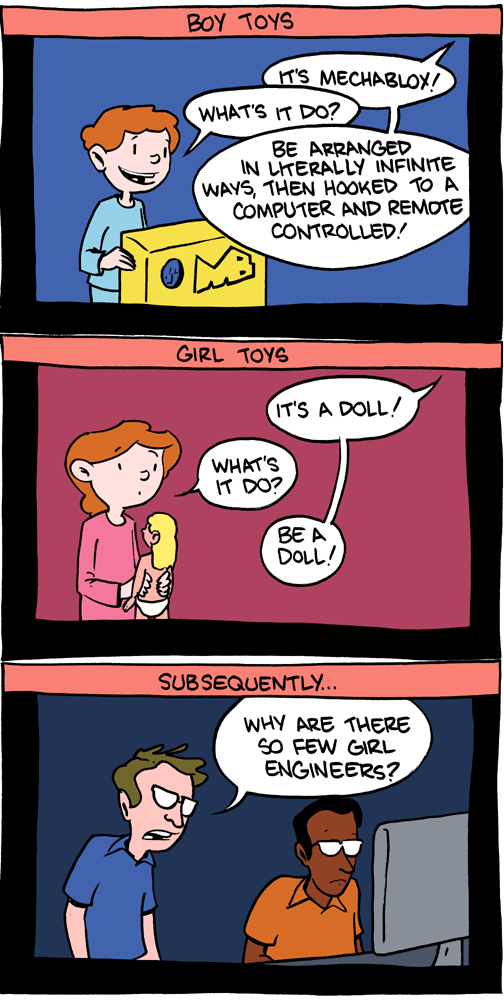
Boy Toys and Girl Toys

This week's blog post is inspired by today's webcomic from Saturday Morning Breakfast Cereal:


Funny and oh-so true.

This got me thinking about the gender divide in theatre and how this could easily be a comic that questions why there are not more female scenic designers. Though changing, young girls are more likely to be exposed to toys that promote girly things, like mothering or fashion-sense. Meanwhile, boys get toys that nurture imagination and, well, engineering.

Personally, I had Barbies and Legos at my fingertips as a young girl. But where I think it makes a world of difference is that I was also exposed to boy things. None of my parents (I have three-- mom, dad, step-mom) ever told me that there were certain things that I could not do because I was girl (like help with building stuff or run around outside making mud pies). Recently I had a discussion with a male friend of mine about playing dress up. He assumed that I had been the typical tom-boy with no interest in girly things like playing princess and wearing pretty clothes. That is incorrect. I loved to play dress up and there are many pictures of me sitting with my flannel nightgown swirled out around me combing the hair of my Barbies and My Little Ponies. Nevertheless, I also knew that on a daily basis I'd much prefer to wear pants so that I could run and jump and climb. I'd say that I viewed the world as an equal-opportunity place.

And then I really started to delve into theatre (and hit puberty) and it became obvious that if I wanted to be the girl who didn't work on costumes I needed to either stick to the painting and props, or I needed to be more butch. I did both, but really embraced my inner tom-boy and set aside all notions of girliness in favor of being "one of the guys." This has continued to this day, bleeding into my friendships and relationships. I have not been considered someone who wears a dress willingly by anybody for the last five years. And I do believe this has a lot to do with my desire to be accepted by the guys in the shop as their equal. Removing the gender markers that clothing provides, I strive to prove my worth as a scenic designer by denying my gender.

Not anymore.

This year I vowed to care more about my appearance and buy clothing because I liked it, which often means because I think it is pretty. This means I now own dresses and skirts and high heels. And the first day that I wore a dress to class this semester, even my professor (who is male) commented on it. And while I can't really wear these clothes in the shop anyway (not just because of safety, I mean, I don't want to have an entire wardrobe of paint clothes), I feel like I have been able to embrace a part of me that has lain dormant because I felt that my gender was a problem. I am going to be the tom-boy and also enjoy wearing frilly dresses. There is a time and place for both and they are not mutually exclusive.

So, I say, give your daughters Legos and Barbies. And your sons too. Allow them to help Dad fix the sink and Mom bake pies. Demonstrate that it is about what you enjoy doing, not what you're supposed to do because of your chromosomes. The world should be equal for all. Sure, it isn't and children will pick up on it, but who knows what kind of ideas might come if they can not only pick out Barbie's prom dress but also design the venue as well.

Friday, April 23, 2010

Becoming a Feminist Designer: Troubling the Traditions of Design

Unconscious process is dangerous… because it denies the political content inherent in artistic process by treating it as neutral. The denial of political content in process acts to covertly censor and marginalize some forms of individual artistic expression.
Raynette Halvorsen Smith 108


For the last ten years I have been on a journey to become a theatre designer. My formal education in design began, as it has for many of my mentors and contemporaries, as a grounded exploration of the ideals and process that were laid out by the great forefathers of design: Edward Gordon Craig, Adolph Appia, and Robert Edmund Jones. However, despite moderate success in the field, I never felt wholly comfortable and capable as a young designer, nor capable of expressing certain design ideas and concepts in creative collaboration. It was not until I studied feminist theory and performance that I became aware of how disconnected I had felt from theatre and dramatic literature up to that point. I began to sense that my struggles with design went beyond the known gender-bias I experienced as a woman in the scene shop, but were connected to a sense of my design sensibilities and process being a round peg trying to operate in the square hole set forth by years of design process laid out by Craig, Jones, and Appia. In recent years, the process and pedagogy of design has been under consideration by many designer-educators across the country and many have chosen to explore design possibilities through a feminist framework. Though the idea of feminist design in theatre is young, it is an apt way to explain the approach of women designers, like myself, who have not only struggled to make a place for themselves in this male-dominated industry, but also challenged the masculine, “unconscious process” that we have been taught to adopt.

Raynette Halvorsen Smith’s article “Deconstructing the Design Process” details in length the problems with the current methods of teaching design, least of which is the notion of the “unconscious process” that “covertly censor[s] and marginalize[s] some forms of individual artistic expression” (108). She asserts that the “design process has become frozen, steeped in tradition—tradition so pervasive that we have become blind to it” (107). This is similar to many feminist art scholars that counter claims that “overtly political representations have no place in art” with the argument that “‘conventional’ art is equally political, the politics having been cast in that ‘neutral’ or masculinist mode that appears invisible” (Hein 449). The nurturing and development of a feminist mode of design will counteract the “unconscious process” with a visual language created from self-awareness in the design process, as well as give vocabulary to and create space for young, female designers’ voices to be heard in the male-dominated industry.

The first step taught in the traditional design process is to read the script and take notes. Arguably, the play-script is the logical place to begin a design because within the words of the play lie the story, emotions, and people that will populate the world of said design. An often used book for design history and process is The Stage is Set by Lee Simonson, in which he states, “In the modern theatre, as in every other, the beginning is in the word” (464). This tradition of privileging the script poses problems beyond design practice, explaining why feminist performance art and many feminist theatrical traditions that favored the visual over the textual arose outside of the walls of the conventional theatre (Smith 110). Similarly, the visual avant-garde has often existed, or at least began, outside of the commercial, mainstream theatres because in other, smaller theatres and performance venues the designer is able, even invited, to break from an extreme servitude to the script and create something that mines the wealth of subtext between the lines.

Nevertheless, the script is still the first port of entry into creating a theatrical design, but at this first step—reading the script and taking notes—feminist theory can and should be applied. Designer Delores Ringer sets forth a series of questions in her article “Re-visioning Scenography” that not only begin to analyze the script in a feminist mode but also illuminate the ways in which artistic aesthetic plays a role in design:

1. In the production I am currently working on, what are the explicit and implicit messages about power in gender relations?
2. How does visual language contribute to these explicit and implicit messages?
3. How do I as a woman and designer relate to the visual language and the world around me? How do I visually process information?
4. How have my relationship with other artists in the theatre and the creative and working process I use been constructed? (299)


One might argue that the first question is one that all designers are already asking, feminist or otherwise. Likely, they do at least note the explicit messages because those are what are most obvious on the page and would be the most universally perceived by the actors, director, and audience members. However, the implicit messages and how they can and should be visually depicted are what create a feminist approach to design.

Ringer used her design for a production of Marsha Norman’s Getting Out to explore ways in which feminism can be visualized on stage. She states that “feminist scenographers can use the trivial and ordinary details of women’s lives as the material with which to make monuments” (302), pointing to her design of painted landscapes on the aprons of the characters to depict how their environment has imprinted them. This kind of approach is an example of how, as a feminist designer, the designer’s duty of visualizing the context in which the story takes place becomes about recognizing the differences in the visualization of the woman’s world verses that of the man’s (Ringer 312). In a traditional design approach, the landscape of the environment might have been made visible in paintings or photographs on the walls, but by painting it across an article of clothing deeply associated with women and their role in life, it creates a more socially charged message about the life of the characters in the play and relates to the feminist performance techniques of using the body as script and canvas.

Furthermore, the designer’s awareness of how to use visual language to illuminate or deconstruct gender and power in the performance of the written word goes beyond the actor and action, but also the space encompassing them. In a discussion about women’s theatrical space, Hanna Scolnicov asserts that “woman is so closely associated with space that almost any articulation of space on stage [. . .] is directly expressive of her position, her lifestyle, her personality” (xiii). Thus, the visual cues provided in scenic design become important in constructing power dynamics in a theatrical piece. Again, in discussing her design for Getting Out, Ringer explains that the decision to arrange the scenery in a “nonlogical fashion” was directly related to making manifest the nonlogical aspects of the past that Arlene, the main character, was facing (302). This departure from Realism is a common approach to feminist art and design , and is important in creating a visual language that does not ignore the explicit and implicit messages of gender power that Ringer asks about in her questions above. It also plays a part in how women designers can grapple with Ringer’s third question: “How do I as a woman and designer relate to the visual language and the world around me? How do I visually process information?” (299) In traditional theatre practices, the pursuit of a unified misĂ© en scene that recedes from the audience’s consciousness is paramount, and is bounded by Realism, because Realism provides the stylistic consistency that is needed to create a design that will recede behind the action of the production. However, the conscious feminist designer’s understanding of her own role as a visual artist allows her to break free of the strictures of Realism to consider hers and others’ interpretations of the visual cues being presented.

By calling attention to the position and interpretation of the designer’s artistic eye, feminist design ideology departs completely from traditional design practices—becoming conscious rather than unconscious—and comes into direct conflict with the great forefathers of design. In The Dramatic Imagination, Jones demands, “Get the personal you out of your work. Who cares about you?” (41) This call for a complete divorce of the artist from their art is impossible, and in any other art form would be considered ridiculous and ignorant. Smith compares the pursuit of the unified artistic vision to that of military discipline, in which any “show of individuality is considered a breakdown in discipline. [. . . And in theatre] where any detection of separate individual artistic expression in the production […] is considered a threat to the ‘willful suspension of disbelief,’ a distraction that weakens the impact of the performance” (113). However, the feminist designer’s choice to depart from Realism creates space for new meanings to be created based on the designer’s own process and aesthetic values, not those provided by history or the playwright or even the director. Furthermore, some scholars define feminist art as approaching “reality from a feminist perspective” (French 69) and feminist performance art as having a quality of “undecidability [. . . . In which] ‘meanings are explosive, ricocheting and fragmenting throughout its audience. The work becomes a situation full of suggestive potentialities, rather than a self-contained whole, determined and final’” (Smith 111). A departure from Realism is needed in order to create this “undecidability” and begins with the designer’s awareness of how she processes visual information. By choosing what images to draw inspiration from and how to mold and edit them into scenic and costume designs, the feminist designer is the first lens through which meaning is created. Awareness of her own role in the creation of meaning for a given production means that the feminist designer will be aware of the audience’s role in the creation of meaning and breaks away from the teachings of traditional design practice which shows “indifference to the philosophical and political meanings embedded in the way that designers work” (Smith 109).

Once the designer has become conscious of the lens through which she views the world and how it effects her work, she can then approach Ringer’s fourth and final question, “How have my relationships with other artists in the theatre and the creative and working process I use been constructed?” Knowing the answers to this question make manifest the ways in which gender-bias in design and the theatre community affect artistic synthesis and output. As discussed before, the necessity of a unified design concept is considered vital in the traditional theatre process and this comes from the hierarchical structure that places the director at the head of the process: the director who is usually male . Thus, the relationships and hierarchy in the creative team become a part of the patriarchal control over design process and product. However, a shift away from a top-down creative process has begun to emerge in theatre. In an informal survey of artistic directors, producers, and stage directors, designer Robert N. Schmidt asked what makes designers more hirable than others:

[. . .] It is no longer sufficient for designers to be able to develop their work in a chameleon-like way from a director’s fully formed ‘concept.’ It is now essential that designers [. . .] function as co-equal artists-helping to initiate rather than merely elaborate upon the director’s theatrical aesthetic style [. . .].” (163)


The philosophy behind scenography, a field that combines at least scenic and costume design and is most common in European theatres, most directly speaks to the necessity of creative partnership rather than a hierarchical structure. In her book What is Scenography? Pamela Howard explains that “to go further scenographically is to work seriously to observe the director’s methods [. . .] the implications of the text, and to use this knowledge to unlock the visual power of the play” (xxiv). The adoption of this philosophy, used scenographically or on an individual design basis, breaks down the militaristic and thus patriarchal hierarchy claimed by Smith previously. This approach allows for a female designer to become equal to her (often male) counterpart, the director.

Furthermore, if a scenographic approach is used, the feminist designer is able to not only escape the traditional patriarchal hierarchy of the director, but also have the opportunity to “regard the entire visual field of the theatre as a ‘landscape’” (Ringer 305), which promotes a wider canvas on which to interpret Scolnicov’s earlier assertion about the intertwined association of woman and space in which “any articulation of space on stage [. . .] is directly expressive of her position, her lifestyle, her personality” (xiii). Moreover, scenography is often described as working from the character outward in order to make “the space speak” (Howard 14). A feminist designer who works in this manner visually places woman and her struggles and growth at the center of the action rather than as “supporting objects surrounding and supporting the male hero” (Ringer 300). This can lead to design decisions like Ringer’s choice to organize the scenery of Getting Out in a non-logical way discussed earlier, or, as in the case of one of my recent designs, the decision to eliminate unnecessary walls in Act III and IV in Chekov’s The Seagull in order to highlight the feeling of entrapment felt by the characters, most of all Nina. Scolnicov argues that “the articulation of [The Seagull’s] theatrical space is [. . .] determined by female motivation” despite the women not being central characters of the play (111). In discussion with the director, the play was identified as “Kostia’s play” and yet I felt that because his troubles were directly linked to his relationship with his mother and Nina, those two women play a more central role in creating the shape of Kostia’s world. However, this notion worked on my process in a wholly subconscious way, making discussion with the director and creative team difficult when trying to articulate the motivation behind my simple design concept. Had I been armed with Ringer’s questions, I may have been able to consciously construct a design as well as articulate my choices. Nevertheless, having explored design through a feminist lens, and appreciating the importance of my own voice and the questions I can ask of the visual language that I am drawn to, the design process feels more open to possibility and success.

Smith asserts that “the pressure of hurdling through the design process to opening night narrows the scope of what can be created” (108), which I would argue is at the heart of why design students struggle and why the field of design has not yet evolved past the theories and ideas set forth nearly a century ago by Jones, Craig, Appia, and Simonson. However, there is hope in the mere fact that veteran designers like Smith and Ringer are also questioning the traditional process of design and putting forth new ways of thinking for themselves and their students. Questions like those posed by Ringer transcend feminist design and lay the groundwork for a new mode of approaching design as a whole. No longer should the designer be presumed invisible in their work, nor just a servant to the script or director. As more women enter the field of design, they too can find themselves in the collaborative art form both as individual artists and partners in the process. By taking Pamela Howard’s assertion that “a theatre designer has to have an insatiable curiosity to find out about things […] to look beyond the surface and discover the truth” (299) to heart, a young female designer can begin to develop her own design process without fear of failure or gender, and with the tools to communicate her new ideas.


Diamond, Elin. Unmasking Mimesis: Essays on Feminism and Theater. New York, Taylor and Francis: 1997. Print.

Dolan, Jill. The Feminist Spectator as Critic. Ann Arbor, University of Michigan Press: 1988. Print.

French, Marilyn. “Is There a Feminist Aesthetic?” Aesthetics in Feminest Perspecive. Ed. Hilde Hein and Carol Korsmeyer. Bloomington, Indiana UP: 1993. 68-76. Print.

Hein, Hilde. “The Role of Feminist Aesthetics in Feminist Theory.” Feminism and Tradition in Aesthetics. Ed. Peggy Zeglin Brand and Carolyn Korsmeyer. University Park, PA, Pennsylvania State UP: 1995. 446-463. Print.

Howard, Pamela. “What is Scenography?” Theatre Design and Technology. Summer 2001: 13-16. Print.

---. What is Scenography? 2nd ed. New York: Routledge, 2009. Print.
Isackes, Richard M. "On the Pedagogy of Theatre Stage Design: A Critique of Practice." Theatre Topics. 18.1 (2008): 41-53. Print.

Jones, Robert Edmond. The Dramatic Imagination. New York: Theatre Art Books, 1969. Print.

New York State Council on the Arts. Report on the Status of Women: A Limited Engagement? By Susan Jonas and Suzanne Bennett. New York: Albany, 2002. Web. 17 April 2010.

Pajaczkowska, Claire. “Issues in Feminist Visual Culture.” Feminist Visual Culture. Ed. Fiona Carson and Claire Pajaczkowska. New York, Routledge: 2001. 1-21. Print.

Ringer, Delores. “Re-Visioning Scenography: A Feminist’s Approach to Design for the Theatre.” Theatre and Feminist Aesthetics. Ed. Karen Laughlin and Catherine Schuler. Madison, Farleigh Dickinson UP: 1995. 299-315. Print.

Schmidt, Robert N. “Training Scenic Designers for a Changing Aesthetic.” Perspectives on Teaching Theatre. Ed. Raynette Halvorsen Smith, Bruce A. McConachie, and Rhonda Blair. New York, Peter Lang: 2001. 160-165. Print.

Scolnicov, Hanna. Woman’s Theatrical Space. New York: Cambridge UP, 1994. Print.

Simonson, Lee. The Stage is Set. New York, Theatre Arts Books: 1963. Print.

Smith, Raynette Halvorsen. “Deconstructing the Design Process: Teaching Scene Design Process Through Feminist Performance Art.” Perspectives on Teaching Theatre. Ed. Raynette Halvorsen Smith, Bruce A. McConachie, and Rhonda Blair. New York, Peter Lang: 2001. 107-116. Print.

Sunday, April 18, 2010

The Search for Feminist Design (Part III)

Part three of the paper, which has really changed in the last week. I will probably post the revised paper at some point, but not as a normal blog update (which I will resume next weekend, promise!).


Once the designer has become conscious of the lens through which she views the world, she can then approach Ringer’s fourth and final question, “How have my relationships with other artists in the theatre and the creative and working process I use been constructed?” Knowing the answers to this question is as important as awareness of personal creative process because they makes manifest the ways in which gender-bias in design and the theatre community affect artistic synthesis and output. As discussed before, the necessity of a unified design concept is considered paramount in the traditional theatre process and this comes from the hierarchical structure that places the director at the head of the process: the director who is usually male. Thus, the relationships and hierarchy in the creative team become a part of the patriarchal control over design process and product. Ringer declares that “the feminist designer should consider herself a creator in her own right, equal to the director; her visual statement is no less important than those made by directors and actors” (306).

This close partnership between director and designer is not only being called for by feminist designers, but also by contemporary directors and producers. In an informal survey of artistic directors, producers, and stage directors, designer Robert N. Schmidt asked what makes designers more hirable than others:
[. . .] It is no longer sufficient for designers to be able to develop their work in a chameleon-like way from a director’s fully formed ‘concept.’ It is now essential that designers [. . .] function as co-equal artists-helping to initiate rather than merely elaborate upon the director’s theatrical aesthetic style[. . .].” (163)

The philosophy behind scenography, a field that combines at least scenic and costume design and is most common in European theatres, most directly speaks to the necessity of creative partnership rather than a hierarchical structure. In her book What is Scenography? Pamela Howard explains that “to go further scenographically is to work seriously to observe the director’s methods [. . .] the implications of the text, and to use this knowledge to unlock the visual power of the play” (xxiv).

By adopting a scenographic approach, the feminist designer not only escapes the traditional patriarchal hierarchy of the director, but also has the opportunity to “regard the entire visual field of the theatre as a ‘landscape’” (Ringer 305), which promotes a wider canvas on which to interpret Scolnicov’s earlier assertion about the intertwined association of woman and space in which “any articulation of space on stage [. . .] is directly expressive of her position, her lifestyle, her personality” (xiii). Furthermore, scenography is often described as working from the character outward in order to make “the space speak” (Howard 14). A feminist designer who works in this manner visually places woman and her struggles and growth at the center of the action rather than as “supporting objects surrounding and supporting the male hero” (Ringer 300). This can lead to design decisions like Ringer’s choice to organize the kitchen in a non-logical way discussed earlier, or the decision to eliminate unnecessary walls in my recent design of Act III and IV in Chekov’s The Seagull in order to highlight the feeling of entrapment felt by the characters, most of all Nina.

Scolnicov argues that “the articulation of [The Seagull’s] theatrical space is [...] determined by female motivation” despite woman not being the central character (111). Until studying feminist theory and design in depth, I was unable to articulate that this idea had subconsciously worked upon my process, which in turn made discussions with the director and creative team difficult when trying to articulate my simple design concept. Smith asserts that “the pressure of hurdling through the design process to opening night narrows the scope of what can be created” (108), which I would argue is at the heart of why the field of design has not yet evolved past the theories and ideas set forth nearly a century ago by Jones, Craig, Appia, and Simonson. However, there is hope in the scholarship of designers like Delores Ringer who set forth her four important questions to ask when embarking on a new design project. Arguably, Ringer’s questions are not applicable to just feminist designers, but instead lay the groundwork for a new mode of approaching design as a whole. No longer should the designer be presumed invisible in their work, nor just a servant to the script or director. As my contemporaries begin to take up the mantle given to us, we can take Pamela Howard’s assertion to heart: “A theatre designer has to have an insatiable curiosity to find out about things, to know where they come from, and why. To look beyond the surface and discover the truth.” (299)


French, Marilyn. “Is There a Feminist Aesthetic?” Aesthetics in Feminest Perspecive. Ed. Hilde Hein and carol Korsmeyer. Bloomington, Indiana UP: 1993. 68-76. Print.

Hein, Hilde. “The Role of Feminist Aesthetics in Feminist Theory.” Feminism and Tradition in Aesthetics. Ed. Peggy Zeglin Brand and Caroylyn Korsmeyer. University Park, PA, Pennsylvania State UP: 1995. 446-463. Print.

Howard, Pamela. “What is Scenography?” Theatre Design and Technology. Summer 2001: 13-16. Print.

---. What is Scenography? 2nd ed. New York: Routledge, 2009. Print.

Jones, Robert Edmond. The Dramatic Imagination. New York: Theatre Art Books, 1969. Print.

Pajaczkowska, Claire. “Issues in Feminist Visual Culture.” Feminist Visual Culture. Ed. Fiona Carson and Claire Pajaczkowska. New York, Routledge: 2001. 1-21. Print.

Ringer, Delores. “Re-Visioning Scenography: A Feminist’s Approach to Design for the Theatre.” Theatre and Feminist Aesthetics. Ed. Karen Laughlin and Catherine Schuler. Madison, Farleigh Dickinson UP: 1995. 299-315. Print.

Schmidt, Robert N. “Training Scenic Designers for a Changing Aesthetic.” Perspectives on Teaching Theatre. Ed. Raynette Halvorsen Smith, Bruce A. McConachie, and Rhonda Blair. New York, Peter Lang: 2001. 160-165. Print.

Scolnicov, Hanna. Woman’s Theatrical Space. New York: Cambridge UP, 1994. Print.
Simonson, Lee. The Stage is Set. New York, Theatre Arts Books: 1963. Print.

Smith, Raynette Halvorsen. “Deconstructing the Design Process: Teachign Scene Design Process Through Feminist Performance Art.” Perspectives on Teaching Theatre. Ed. Raynette Halvorsen Smith, Bruce A. McConachie, and Rhonda Blair. New York, Peter Lang: 2001. 107-116. Print.

Sunday, April 11, 2010

The Search for Feminist Design (Part II)

This is the second part of the feminist design paper. There are still about 3 more pages to go. It hasn't been done-over with a re-write since receiving comments back from the professor, but I figured that it would be better to stick with this draft since there will be some major restructuring in the final draft. As always, love your comments, feedback, or questions.


Ringer uses her design for a production of Marsha Norman’s Getting Out to explore ways in which feminism can be visualized on stage. She states that “feminist scenographers can use the trivial and ordinary details of women’s lives as the material with which to make monuments” (302), pointing to her design of painted landscapes on the aprons of the characters to depict how their environment has imprinted them. This kind of approach is an example of how, as a feminist designer, the designer’s duty of visualizing the context in which the story takes place becomes about recognizing the differences in the visualization of the woman’s world verses that of the man’s (Ringer 312). In a traditional design approach, the landscape of the environment might have been made visible in paintings or photographs on the walls, but by painting it across an article of clothing deeply associated with women and their role in life, it creates a more socially charged message about the life of the characters in the play and relates to the feminist performance techniques of using the body as script and canvas.

Furthermore, the designer’s awareness of how to use visual language to illuminate or deconstruct gender and power in the performance of written word goes beyond the actor and action, but also the space encompassing them. In a discussion about women’s theatrical space, Hanna Scolnicov asserts that “woman is so closely associated with space that almost any articulation of space on stage [. . .] is directly expressive of her position, her lifestyle, her personality” (xiii). Thus, the visual cues provided in scenic design become important in constructing power dynamics in a theatrical piece. Again, in discussing her design for Getting Out, Ringer explains that the decision to arrange the scenery in a “nonlogical fashion” was directly related to making manifest the nonlogical aspects of the past that Arlene, the main character, was facing (302). This departure from Realism is a common approach to feminist art and design, and is important in creating a visual language that does not ignore the explicit and implicit messages of gender power that Ringer asks about in her questions above. It is also a way in which women designers can grapple with Ringer’s third question: “How do I as a woman and designer relate to the visual language and the world around me? How do I visually process information?” (299)

Calling attention to the position and interpretation of the designer’s artistic eye is the point at which feminist design departs completely from traditional design practices—becoming conscious rather than unconscious—and comes into direct conflict with the great forefathers of design. In The Dramatic Imagination, Jones demands, “Get the personal you out of your work. Who cares about you?” (41). This call for a complete divorce of the artist from their art is impossible, and in any other art form would be considered ridiculous and ignorant. However, traditional theatrical design practices require a seamless misĂ© en scene that disappears from the consciousness of the spectator. Smith likens the emphasis put upon fusing many artistic visions under one, unifying concept to that of military discipline, in which any “show of individuality is considered a breakdown in discipline. [. . . And in theatre] where any detection of separate individual artistic expression in the production […] is considered a threat to the ‘willful suspension of disbelief,’ a distraction that weakens the impact of the performance” (113).

The creation of a unified design that recedes from the audience’s conscious is bounded by Realism, because at the heart of Realism is the stylistic consistency that is needed to create a design that will recede behind the action of the production. However, some scholars define feminist art as approaching “reality from a feminist perspective” (French 69) and feminist performance art as having a quality of “undecidability [. . . . In which] ‘meanings are explosive, ricocheting and fragmenting throughout its audience. The work becomes a situation full of suggestive potentialities, rather than a self-contained whole, determined and final’” (Smith 111). The departure from Realism needed in order to create this “undecidability” begins with the designer’s awareness of how she processes visual information. The feminist designer is the first lens through which meaning is created, by choosing what images to draw inspiration from and how to mold and edit them into scenic and costume designs. Awareness of her role in the creation of meaning for a given production means that the feminist designer will be aware of the audience’s consumption of that meaning and breaks away from the teachings of traditional design practice which shows “indifference to the philosophical and political meanings embedded in the way that designers work” (Smith 109).

(To be continued...)


French, Marilyn. “Is There a Feminist Aesthetic?” Aesthetics in Feminest Perspecive. Ed. Hilde Hein and carol Korsmeyer. Bloomington, Indiana UP: 1993. 68-76. Print.

Hein, Hilde. “The Role of Feminist Aesthetics in Feminist Theory.” Feminism and Tradition in Aesthetics. Ed. Peggy Zeglin Brand and Caroylyn Korsmeyer. University Park, PA, Pennsylvania State UP: 1995. 446-463. Print.

Jones, Robert Edmond. The Dramatic Imagination. New York: Theatre Art Books, 1969. Print.

Ringer, Delores. “Re-Visioning Scenography: A Feminist’s Approach to Design for the Theatre.” Theatre and Feminist Aesthetics. Ed. Karen Laughlin and Catherine Schuler. Madison, Farleigh Dickinson UP: 1995. 299-315. Print.

Scolnicov, Hanna. Woman’s Theatrical Space. New York: Cambridge UP, 1994. Print.

Simonson, Lee. The Stage is Set. New York, Theatre Arts Books: 1963. Print.

Smith, Raynette Halvorsen. “Deconstructing the Design Process: Teachign Scene Design Process Through Feminist Performance Art.” Perspectives on Teaching Theatre. Ed. Raynet Halvorsen Smith, Bruce A. McConachie, and Rhonda Blair. New York, Peter Lang: 2001. 107-116. Print