Friday, September 15, 2017

Designer's Notebook: Why We Have A Body at Strawberry Theatre Workshop

Mahria Zook as Renee and Alyssa Keene as Lili.
Photo by John Ulman.
Last night I opened my sixth show of 2017: Why We Have a Body by Claire Chafee at Strawberry Theatre Workshop here in Seattle. I was brought onto this project about seven weeks ago in a hurried conversation with director Rhonda J Soikowski who reached out to me on the recommendation of one of her colleagues. Rhonda pitched the show -- a four-hander that explores the role of gender, sexuality, mental illness, and family and was a sensation in the 1990s. Immediately images of pleated pants and shoulder pads flashed through my head.

Just a month before this call, I had made a decision to be more picky about the shows that I take on. My more stringent criteria was not about pay or working conditions but about the mission of the organization and/or the voices that would be amplified by the project. Coming off of one big musical with over 80% white or white-passing actors in the cast into a three-hander with an all-white cast and creative team, and then going into production managing and designing for Sound Theatre Company's Hoodoo Love by Katori Hall, there was a light bulb that went off in my head. I could only give my energy and life-blood (which is what we freelancer do give) to companies and shows that put their money where their mouth was and elevated under-represented and vulnerable voices in order to disrupt the white supremacy we are all now too familiar with in Trump's America. (Yes, duh.)

Rhonda's call and request for me to squeeze Chafee's non-linear, monologue-filled examination of women writing their own definition and future in a patriarchal world was my first test of my conviction. I had planned August to be a month of recuperation and preparation for the last of my 2017 shows. And yet, this was not a case of not being able to say no, which I definitely am afflicted by. This show was calling to me.

Back in my Feminist Theatre class in grad school at UNC Greensboro, I wrote a paper called "Becoming a Feminist Designer: Troubling the Traditions of Design." In the paper, I dissected traditional theatre design techniques and pedagogy using a third-wave feminist framework. It was the beginning of putting into words something I had long felt in my bones: my identity is imprinted on my designs and adds (positive and/or negative) value to them. And, by that logic, so does the identity of any designer. Thus, who is designing a production is as important as who is directing it, who is acting in it, and what it is about.

But I was only scratching the surface, struggling to apply inadequate language and theory to something much, much bigger than this.

Enter intersectionality.

Coined by civil rights activist KimberlĂ© Williams Crenshaw in 1989 essay, intersectionality is the complex, cumulative manner in which the effects of different forms of discrimination combine, overlap, or intersect. Now, in 2017, intersectionality is being used to expand our understanding of identity, white supremacy, and white privilege.

I have a more indepth write up about what I'm beginning to coin intersectional design practices (instead of feminist design theory), but the gist of it is that, as a designer, you have to interrogate your own position of power and privilege, interrogate the expected audience's, and then, and only then, do you start to break out the design decisions that build the world or clothe the characters. (Again, more later.)

So, back to Why We Have a Body for which I acted as the costume designer.

In Chafee's stage directions, she explicitly calls out various costume needs like Mary's orange coveralls and Eleanor's bib-waders, but it is in her stage directions for Renee, the married paleontologist caught in a love affair with female private investigator Lili, that demands an understanding of gender performance of the 1990s -- because that's when the play was written (and our production was set) -- and that of 2017. While in Mexico, trying to patch things up with her perpetually off-stage husband, Chafee's stage directions read, "She gives a tiny wave. Picks up his wallet, and she picks up his watch and puts it on. She feels its weight on her wrist...feels what it's like to wear a man's watch. She stares out." In that little ellipses, Chafee is telegraphing the subtext of Renee's navigation of her identity just a few scenes after we've heard her say to Lili, "Maybe I'm a man. Is that a possibility? I feel like a man..."

Oh, oh, oh, oh, oh.

I'm not going to do a thorough job unpacking this -- this blog post is not intended to be an academic paper -- but can you see the power of identity, gender performance, and power all wrapped up in the act of a woman wearing a man's watch? Layer onto that the very real trajectory of gender expression in the 1990s LGBTQ+ community, what was fueling Chafee's script, and this costume/prop piece is explicitly emblematic of what each stitch of clothing means in conveying character to drive the narrative as well as bring the audience along on that journey.

This stage direction is an explicit demand of Chafee that particular attention had to be paid to the costumes of these characters. As a cis-gender, heterosexual female, I knew I needed to rely on the authorities in the room to guide me. I had to unpack my privilege and experience to know that while I might think something looks right or is the right price, I am not the authority on that.

On the night of preview, I gave the actress a new watch -- we had been using a personal piece that I didn't want to risk during the show -- and while it fit as a 1990s men's gold watch, on stage it read more as a woman's watch. I saw it that way, from the other side of the audience. But, more importantly, Rhonda (the director), who had told me in my initial phone conversation about the personal connection she has with the play as a "lesbian of a certain age", told me it wasn't right. Because--and this is why intersectional design is more than just applying an understanding of the intersections of oppression and power but is in fact about navigating the intersections of the history of that oppression and power as defined by modern, regional, and generational understanding of our world--what a 2017 audience knows as an undoubtedly "heavily coded masculine" watch (which were the exact notes in a rehearsal report for the watch) is an almost comically large metal watch.

While there were so many other in-depth conversations about the costumes as they pertained to the presentation of each character that I could go into, the story about the watch is the epitome of how design must take into account everyone from the playwright to the director to the audience, and also the designer herself.

It was a such a wonderful opportunity to hone my definition and understanding of the intersectional design process with a play that demands it. I'm grateful that I said yes and I hope that, in my more curated 2018 season, these opportunities will multiply. But I am also excited to start formulating and sharing out this philosophy with the world.

--

See Straw Shop's Why We Have a Body by visiting the brown paper ticket page.


Sunday, June 11, 2017

Even Plays That Interrogate Racism in America Can Uphold White Privilege: Welcome to Braggsville at Book-It Repertory

Ku Klux Klan Gathering, Crystal Pool (2nd and Lenora) in Downtown Seattle, WA. March 23, 1923.
Photo courtesy of the Washington State Historical Society

It has been a long while since I left a theatre performance physically ill. Thinking back, I believe it might have been the night I left Bad Apples during the second intermission.

I admit that I don't know the source material -- T. Geronimo Johnson's lauded novel Welcome to Braggsville -- but the adaptation and staging of it by Daemond Arindell (co-adapter) and Josh Aaseng (co-adapter/director) that I sat through at Center Theatre last night left me wanting to scream into the night.

Why?

Because this production is masquerading as something it is not. Because, for being a show billed as a satirical interrogation of white supremacy (in the American South), it fails.

Why?

Because the person we, the audience, are meant to empathize with is the white guy : D'Aron Davenport, born and raised in the eponymous, fictional Georgia town of Braggsville where he was called a faggot because he was smart and sweet and sensitive, or so we are immediately told in the opening lines of the play. All that to set us up to see him as an outcast from his hometown and elicit sympathy from the audience.

The show follows D'Aron and his three friends -- "the four little Indians" (which is NEVER unpacked) -- on a journey to stage a "performative intervention" during a Civil War Battle re-enactment in D'Aron's hometown. The dramatic fallout of their ill-advised "intervention" -- a staging of a lynching in the midst of said-re-enactment -- is the sub-plot of the play. What, then, is the main thrust of the nearly 3-hour show?

It is not about how Charlie, the one black member of the quartet parses the experience of being thrust into the racial tensions of a Confederate-flag-waving community while being asked to play the lynching victim for "authenticity."

It is not a dissection of the culturally-appropriating behavior of the dread-locked Becky that comes up with the whole idea in the first place.

And it is not even an analysis of the racist behavior of the Chinese -- sorry, Malaysian -- comedian of the group who primarily appears to provide comic relief, even in the aftermath of the lynching-gone-wrong while he sports, among other problematic accoutrements, a spray-painted red clown wig.

Instead, the play focuses on the hometown boy learning about how the years of saturation and maturation he spent steeped in a stereotypical, Confederate-proud Southern town has actually made him a pawn in the white supremacist hatred that he and his three friends have come to town to protest in the first place. Which could be useful and interesting for a we're-not-racist-Seattle audience, except....

Every opportunity presented to interrogate the white guy's journey down the rabbit hole of his complacency in the violent, destructive race relations in America -- from a powerful and yet ineffective slam poetry-style dialogue between D'Aron and the black narrator/poet to D'Aron's final line of the play going completely unchecked by any dramatic reaction by the characters, actors, or, hell, dramatic environment itself -- is completely lost. Making this production, which is actually full of beautiful performances and a fantastic design, yet another opportunity to uphold the white privilege and soothe the white fragility that actually underlies the decision of some white Southerners to get the Confederate flag tattooed on both of their forearms, to re-enact Confederate battles, and to use the N-word in everyday speech without any consequence. More importantly, this production reinforces Seattle's own "we're not racist" mindset while this weekend one floor above the theatre was Festival Sundiata celebrating Black history, culture, and accomplishments that included tables full of documentation and commentary about Seattle's racist history from red-lining to KKK gatherings (oh yes, we had our own klan).

How does it do that?

The reasons hinge much on action I do not want to give away in case you're on your way to see the show, but let me start with the simple fact that the story takes place in rural Georgia. Did we not see the disjointed, "racism/bigotry/ass-backward thinking doesn't happen here" mindset during our 2016 election? It's too easy for white Americans outside of the South to distance ourselves from the cultural, systematic, and historic racism that is overtly played out in small, rural communities in the South because that racism doesn't look like our racism. And yet, it's all connected because our entire country was founded and populated by the same people and laws that originated in the 13 colonies. And I point, once again, to the fact that Seattle had it's own KKK activities, which means our hands are very much not clean, let alone for our decimation of the native tribes of the Duwamish, the internment of the Japanese, and countless other acts of white supremacy.

Along with the geographic/emotional distance inherent in the location of the play, let me give away one plot point to drive this home: D'Aron doesn't change. No, he doesn't. Faced with the brutal, violent truth of his family's and community's role in the oppression of the black people of "the gully", he chooses to protect them. HE CHOOSES TO PROTECT HIS FAMILY AND TOWN. And the only response to that is a well-delivered but lost punctuation point about how what we saw in Braggsville is not unique to the South, delivered by Charlie (remember, the black member of the "four little Indians") before lights out and curtain call.

Again, I can't speak to the source material, but I am going to call a spade a spade: Welcome to Braggsville, while it attempts a running leap at vaulting over white privilege and fragility in the hopes of sparking conversation and inciting change, it falls flat and keeps the white audience firmly on the side of not dealing with our white privilege and our role in white supremacy. It does not dare us to stand up against all odds, our family, our community and call out behavior that is insidiously reinforcing white supremacy because poor D'Aron -- who does honestly struggle with realizing how he has internalized years of racism just by being alive in such a community -- isn't forced to. We even get to watch him cry tears of white fragility as he draws parallels between a survivor of the atom bomb explosions in Japan being protected because he was underwater only to resurface and see his family, friends, and village destroyed, shadows of their former self (if that isn't a poetic interpretation of Robin DiAngelo's "we're all swimming in the same water" of racism, I don't know what is).

In 2017, we should be past showing that white people are just now realizing there is racism that they just didn't know about. The stories we need to be telling, that will truly change our society and the world, are the stories that force those same white people past their fragility and into action. Barring that, the producing company has to shepherd further conversation around the play through talk backs, dramaturgical resources, lobby displays, and continued conversation through public outreach.

If you do go see the show, white Seattle, do me a favor and look around at who is in the audience and how they react. The night I saw it, there were maybe 10-15 people of color and they were not standing en masse like the white audience at curtain call. Why? Because I don't think this play was a revelation to them. And it shouldn't be a revelation to any of you, either.

Wednesday, September 28, 2016

Catharsis: The Royale @ ACT


Show: The Royale: A Play in Six Rounds; by Marco Ramirez
Theatre: ACT; Seattle, WA
Tickets: ACT Pass
Date & Time: Sunday, September 26, 2016 @ 2pm

Okay, an important bit of information is that I went to see this play after spending around 24 hours over 4 days taking an ArtEquity intensive. For four days we worked on establishing a basis for understanding and identifying white supremacy, oppression, and inequalities due to gender, race, sexuality (to name a few) in society that have been perpetuated for hundreds of years in our country. It was a very intense experience and to finish it off by watching a play that drives each of those points home was, as my title alludes to, an extremely cathartic experience.

The Royale is inspired by the historical, groundbreaking boxer Jack Johnson who was the first black heavyweight champion from 1908 to 1915. Ramirez's play explores Johnson's story leading up to his first fight against the fictional white heavyweight champion Bernard "The Champ" Bixby. The script deftly runs Johnson's desire to be the best boxer alongside his struggle against racism and Jim Crow Laws, pitting his egoism and selfish lifestyle against his dedication and love of his sister. The play itself is beautiful and cutting at a time when our nation is struggling with extreme violence against men and boys of color. During an interview with press, Johnson tackles the fact that his athleticism and talent are explained away by the fact that "his kind" are prone to violence, so of course he would be drawn to boxing.

But, as is the case with many plays, it is the entire package that makes this a memorable show. Because I follow these things, I was excited to follow the interviews and write ups about director Ameenah Kaplan's approach to the show. Kaplan was part of the original company of STOMP and, per her wikipedia page, has been drumming since age 12. Her relationship with movement and percussion shine through the staging of The Royale. As she says in the interview found in the program, "...rhythm.... It calms, it soothes, and it informs." The rhythmic performance of the script, from the boxing moves to underscoring important lines, most definitely informs the story and pushes this play beyond a simple "based on the life of" and into the realm of immediate, necessary, and heart-rending.

I also must comment on Carey Wong's beautiful set. If you know anything about my own aesthetic, it will come as no surprise how much I believe that the bare stage of this show with just four stools is exactly what this show needed. The barebones of a boxing ring, the platform allows the story, the words, the people to take precedence over the visual world, which is exactly how scenery should act. It also makes the moment when the boxing ring is created for the final face-off of Johnson that much more powerful. The caging of "the grizzly bear" is complete and the audience can't help but be struck by Johnson's courage in the face of societal and personal demons.

But more than the excellence of this production, which ACT rarely disappoints on, is how important it is that this story was chosen for the main stage season of a LORT company. When so many seasons at the leading theatres in Seattle and the country are written and directed by and starring predominately white males, to have a production that celebrates and analyzes the racial injustices of then and now while celebrating talented artists that are often relegated to second string companies is important. My ArtEquity training is showing, but I have been so disappointed by the lack of diverse stories available to my communities by the theatres I work with and/or admire. The day before I attended this performance, I was fortunate enough to attend The Black Women Wisdom Summit, curated by Valerie Curtis-Newton and hosted by The Hansberry Project and Intiman Theatre. During the rich, honest conversation between the 11 black women playwrights and Curtis-Newton, a simple truth of the lack of diverse representation became clear. Dominique Morisseau said it best (and do go read the article/transcript from Seattle Weekly linked above for more pearls of wisdom):

"Whose universe? Saying that work should be 'universal' is code for work that should be appreciated and understood by a white audience. So universal becomes code for white, and then we’ve got a white universe, and I’m like, hold on. The thing about universality is that we are all a part of the universe, so every work is universal. And if you aren’t writing from a specific place, where are you writing from?"
This question of "where are you writing from" can be broadened to include directors and designers who shape the world on stage, and the artistic teams that are programming what worlds are on the stage in the first place.

If you are on the fence about seeing this show, go! It runs through October 9th. There are a ton of ways to get discounted tickets at ACT that you may not know about. Including Pay What You Can on Sundays, $20 on Tuesdays, and $15 tickets to students/Under 25! You will not be disappointed to spend your money to see this production.
--

And now, some stats:

# of Actors: 5
# of Female Characters: 1
# of Non-white Characters/Performers: 4

# of Artistic Team Members Listed on Title Page of Program: 9
# of Female Artistic Team Members: 4
(including: Director, Costume Designer, Asst Lighting Designer, and Production Assistant)

Saturday, July 30, 2016

Then is Now: Daisy @ ACT

Quarter-Inch Scale Model of the Set Design of Daisy
designed by Shawn Ketchum Johnson
Show: Daisy; by Sean Devine
Theatre: ACT; Seattle, WA
Tickets: ACT Pass
Date & Time: Friday, July 29, 2016 @ 8pm

I went into this show 100% skeptical that I'd enjoy myself. A play about the advertising campaign to elect Lyndon B Johnson in 1964? Didn't we JUST do this at The Seattle Rep and Oregon Shakespeare Festival with All the Way and The Great Society? Why are playwrights so obsessed with this time in American politics? As a 32-year-old, the pitch of the parallels of the political climate of LBJ's terms with today feels more like a half-ass attempt to make a story that appeals to the majority of the aging theatre audiences appeal to my demographic and younger.

Which means that I was pleasantly surprised by this evening of theatre.

It started by attending the ACTPass Member Party on the roof of ACT. As a former audience services employee, I was totally down to be on the receiving end of the carefully constructed social event to entice members/subscribers to feel invested in the theatre beyond the usual ticket purchase. That is why I was able to snap a picture of the set model above. Peppered around the room that the gathering was held in were costume plates, scenic drawings, and models for Daisy and the shows that had come before (Stupid Fucking Bird and The Mystery of Love and Sex). As a designer, this kind of insight is super cool to me and I always nerd out over seeing the art that will be full-scale, 3-D that evening. I was not the only person inspecting these artifacts, so I know it's not just my specific brand of nerdiness that this appeals to.

Once we sat down to see the show, I was immediately impressed with the scale of the wall of TVs that was created for the show. An innovative way to both incorporate the media that the story of the play centers around, but also allow for projections that indicate place, time, and other story elements that advance the story. Interestingly, my date for the evening, a friend from high school, and I compared notes about the first TVs we remembered being like one of the TVs in the back wall. Despite our generational distance from 1964, we still felt a connection to it. This got me to thinking about the kind of nostalgia that I worried that this and plays like All the Way and The Great Society produce in the average theatre patron of the large theatre houses. Looking around the audience last night, I can attest that we were two of the youngest people sitting in the theatre. Even during the usual last-minute rush-ticket seating, the average age of the audience pushed well north of 50.

And that's unfortunate.

Unlike Robert Schenkkan's plays, which really operate as historical dramas of the LBJ presidency, Daisy, while based on true events, analyzes the human component of people grappling with the changing political landscape of the 1960s, specifically the terror that gripped the country on the verge of a war with Vietnam. The play centers around the ethics of a ground-breaking commercial that aimed to paint Barry Goldwater as a nuclear-trigger-happy candidate for president while not outright saying that. The advertising team struggles with the manipulation of praying on America's worst fears in such a blatant way. See the ad below:


As the dramaturgical material in the program and throughout the lobby, it is eerie how many people of America viewed Barry Goldwater as a crazy, off-kilter candidate who could not, should not be the Republican nominee, let alone the next president of the United States. This ad, nick-named "Daisy" by the team, was a calculated move to incite fear at the alternative to voting for LBJ. The team went on to receive harsh rebuke by the public and other politicians, but also to receive praise for the change in advertising tactics that the spot marked.

This glimpse into history is enough to make this play worth a viewing.

But this world-premiere at ACT of a play that they helped develop in the Icicle Creek New Play Festival, is one of the most deft productions I've seen at ACT. From the set design (see more work by Shawn Ketchum Johnson) to the staging, this piece gives me hope that theatre in Seattle is not just stagnating.

That said, I still took issue with some things. In order to diversify the cast, the one non-white actor was a composite character made up of newspaper journalists and civil right's leaders. The female character in the piece existed because the playwright up and changed one of the real-life ad-men into a woman. I appreciate the effort, but let's be honest with ourselves about how the choice to program a play about this time period means that the diversity of gender and race on stage is going to be lacking. To completely change historical characters so that the diversity numbers check some boxes is as much a pandering to the audience as it is a disservice to the people that the story is about.

Also, why isn't this play being peddled in such a way to attract a diverse audience base? As it stands, if this play only primarily reaches the typical ACT audience base, it is a piece of nostalgia (per my anecdotal experience of listening to the audience sitting around us). Without a wider audience base that is younger and more racially diverse, then the lessons to be learned about how we are doomed to repeat our mistakes through inaction at the polls this fall are only things written about in the program and The Seattle Times. And yes, I believe the marketing efforts and ticket prices are as much a point to review as the production itself.

The show runs for another week. I recommend heading out to see it if you can. There are a ton of ways to get discounted tickets at ACT that you may not know about. Including Pay What You Can on Sundays, $20 on Tuesdays, and $15 tickets to students/Under 25! You will not be disappointed to spend your money to see this production. AND you'll likely be more terrified of what we are facing in 2016.

---

And now, some stats:

# of Actors: 6
# of Female Characters: 1
# of Non-white Characters: 1

# of Artistic Team Members Listed on Title Page of Program: 12
# of Female Artistic Team Members: 3
(including: Costume Designer, Assistant Costume Designer, and Dramaturg)

Sunday, July 24, 2016

Light and Frothy: Singin' In The Rain @ Leavenworth Summer Theatre

Show: Singin' In the Rain; book by Betty Comden & Adolph Green, lyrics by Arthur Freed, music by Nacio Herb Brown
Theatre: Leavenworth Summer Theatre; Leavenworth, WA
Tickets: Comp
Date & Time: Thursday, July 21, 2016 @ 8pm

First, let me lay out the why of seeing this show. I headed to the little Bavarian town east of Seattle to support my friend, Phil Lacey, in the lead roll of Don Lockwood. As he put it, I was being given the opportunity to see a rare treat as he has more recently transitioned to working primarily as a director.

Now that you know why I drove three hours to see a show, it's also fair to admit that I went into the evening with low expectations. In part because the last time I saw a production of Singing' in the Rain was at a community theatre in Rockwall, TX, starring a bunch of teenagers. But also because Leavenworth Summer Theatre is true summer stock theatre. With a cult-like following among the returning artists, the three shows produced every summer are rehearsed and performed in grueling repertory in three different locations that LST has the fortune of renting from the Parks Department. As you may be able to tell from my photo above, Singin' in the Rain is performed on a covered stage at the Leavenworth Fish Hatchery run by US Fish and Wildlife. The audience sits on folding chairs that are arranged on a gentle slope. Other than the folding chair part, the opportunity to sit outside, surrounded by the beautiful backdrop of hills and evergreen trees as the sun goes down in midsummer is pretty special. Which I'm sure contributes to why the house was packed. For instance, the two families that were sitting beside me were taking a break from their camping vacation. The family to my right had been coming to LST for many, many years and were convincing another neighbor to be sure to catch The Sound of Music as it was "the best year yet." As a newbie to the LST experience, the utter lack of cynicism that you often catch snippets of sitting in the Seattle theatres was refreshing and downright infectious.

Low expectations aside, the show was really quite enjoyable. The stage version was adapted from the 1952 movie staring Gene Kelley, Donald O'Connor, and Debbie Reynolds. Without a big budget and technically advanced theatre space, creating the scenic world of Singin' in the Rain is a difficult task.The show jumps between interior and exterior locations ranging from "outside Graumann's Chinese Theatre" to "An Empty Soundstage" to "Hollywood Boulevard." The stage version feels shoe-horned into the musical conceit of in-one scenes to allow for scene shifts to happen upstage of a curtain or scrim. This particular production relied on wagons that were changed out upstage of a red curtain. And, most importantly, they had the requisite rain during the titular song that closes Act 1. (The show I saw in Rockwall, TX relied on a mylar rain curtain.) I also have to mention that I was downright floored by some of the costumes that walked on stage. On that stage was proof that there are some really well-maintained stocks that can give the big rental houses a run for their money for one of the hardest parts of costuming a musical: matching chorus costumes.

If we take Singin' in the Rain for what it is--frothy entertainment--and put it in communities like Leavenworth built around charming the pants off tourists with the faux-Bavarian facades, then my evening was a success. I got to see my friend tap dance "in the rain" and to congratulate another talented actor, Morgan Bader, who I worked with on South Pacific on yet another hilarious turn on the stage. And, as I overheard one woman in the audience, it's refreshing to just enjoy affordable theatre rather than feeling fleeced by the ticket prices in Seattle for shows that leave you feeling meh. Next time I hope I'll have more time to enjoy Leavenworth and take in LST's crown jewel: Sound of Music set atop the ski hill.

--

And now, some stats:

# of Actors: 24 (approx)
# of Female Characters: 5 named (+ 8 ensemble)
# of Non-white Characters/Performers: 0

# of Artistic Team Members Listed on Title Page of Program: 15
# of Female Artistic Team Members: 9
(including: Director, Assistant to the Director, Choreographer, Assistant to the Costumer, Scenic Artist, Sound Board Operator, Light Board Operator, Props Master, and Costume Mistress)

Monday, June 20, 2016

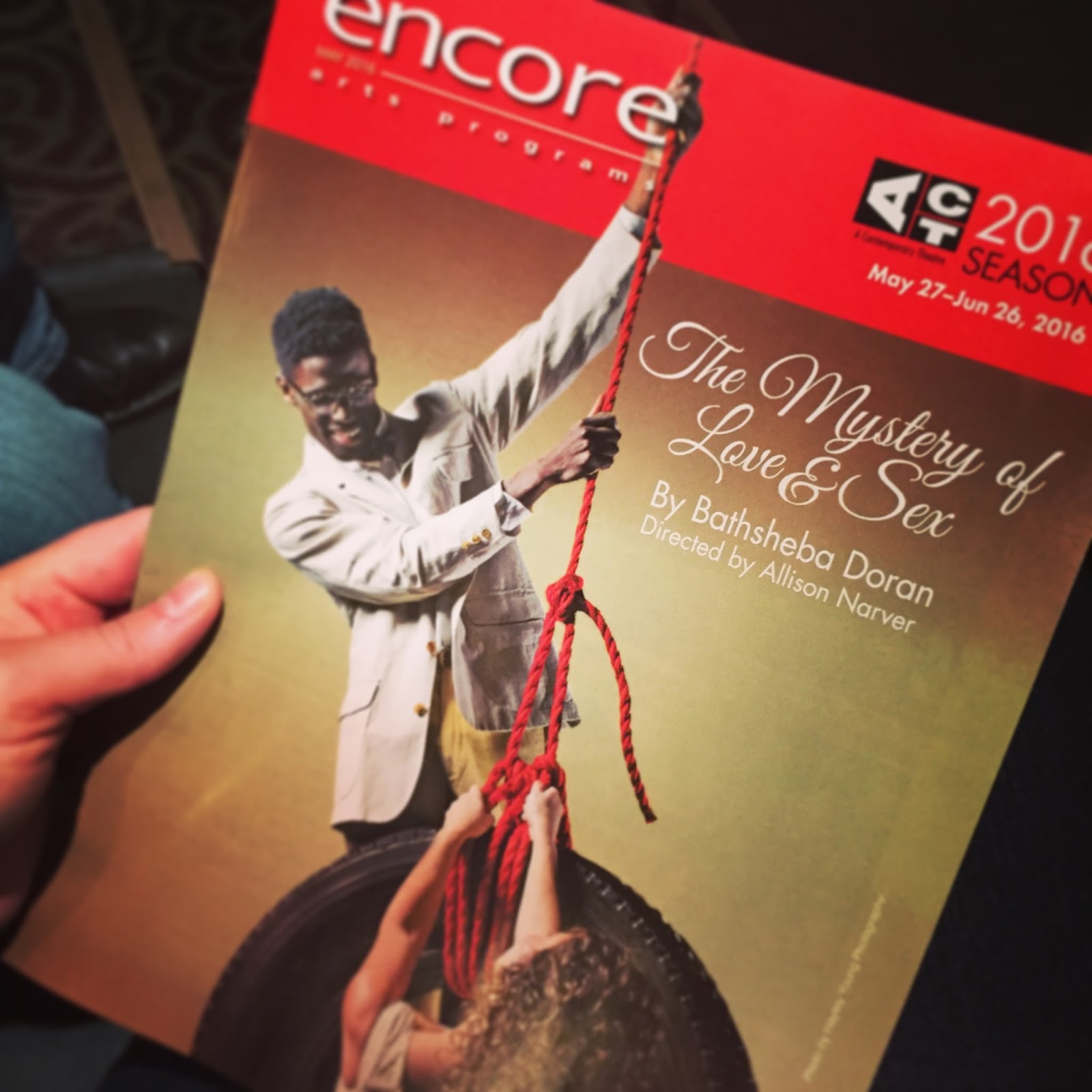
Bubblegum Part 2 : The Mystery of Love & Sex @ ACT

Time to put this idea into practice.

Show: The Mystery of Love & Sex by Bathsheba Doran
Theatre: ACT in Seattle
Tickets: ACTPass Membership
Date & Time: Sunday, June 19th @ 7pm

One of the things I've been told I need to do with these is to lay out my expectations of the show. In that vein I must divulge that I went into this show a little unsure. This was the show that was labeled "bubblegum" by a colleague a few weeks ago. I tried to go into this viewing with an open-mind, but that critique was there and to pretend it wasn't is a disservice. Keeping that in mind:

Overall, the show was good. Despite being three weeks into the run and the last night of a long week of shows, the energy of the cast was there. I was wholly impressed with the commitment to the characters on stage by the actors. I'll admit I spent an unnecessary amount of the first act trying to remember that I'd just recently seen Emily Chisholm in Outside Mullingar at The Rep last season. But I tend to obsess over things like that until I can re-read the program looking for an answer.

Since I chose to lead with the assessment of the energy of the piece, that might point to whether I, too, imagine it to be bubblegum. To be clear, the explanation of bubblegum theatre is: "Sure it has flavors of racial struggle or LGBT oppression or meta-theatrical-revolution. But then you chew on it for a couple hours, it loses all flavor, and it ends up being tossed out with the program." I found myself saying to my husband at intermission, things felt too superficial. There were so many issues being tackled by the play--race, religion, sexuality, politics, socio-economics, gender roles, etc--that no one thing felt, at that point, to be given enough attention to feel worthwhile. I still felt that way at the end of the show, my opinion countered with the observation that, well, isn't that life? Do we actually spend every waking moment dealing with one or two BIG issues or are they all converging at the same time, bouncing off of one another, and changing with every passing moment and interaction? True. And perhaps it's my cynicism, but I want theatre to gob-smack me a little bit more and not feel so nicely tied up in a bow at the end.

And here's an important thing to ask: Am I the intended audience for this play? Or is the intended audience your average person who makes their living outside of the arts and who might, in fact, not question gender and sexuality politics on a daily basis. The average person who needs to unpack their feelings about being titillated by the nudity of the young female character in Act 1 but feeling like the nudity of the young man in Act 2 is gratuitous. Maybe the average person who thinks it's unlikely that both young characters explore homosexual relationships and have no interest in exploring a heterosexual relationship with one another. Etc.

No, I'm not really the intended audience member. The goal of this production is not to wow the theatre artists in the room. If it had been the set probably wouldn't have been such a simple answer to the many locations called for in the play (6, if you're counting, ranging from dorm room to backyard). It was elegant and effective and I think quite well done, but it was, for me with my set designer hat on, a little too static (despite multiple moving pieces). If it had been about the theatre artists in the room, they probably would not have used the door sound effect that I've heard in other productions in the Allen Theatre because for some reason when an actor walks into the vom* we won't intuit they go through an imaginary door in the imaginary walls unless we hear the sound of it open and close. Really, if it had been about the theatre artists in the room, would the play have been presented at all? Or, if it had, would it have been done in a post-apocolyptic, gender-bending manner that so many theatre artists employ to inject something into your average play? Maybe. Maybe not.

So again, the play was good. I laughed. I thought some things (often quickly brought out of deep thinking by the jokes). I even teared up at the end thinking of the meaning of friendship as the bow was tied nicely around the story. However, it isn't going to stick with me long term and maybe that means it's bubblegum. Or maybe it's just a production that exists. I feel neither robbed of my evening nor galvanized to make changes in the world at large or in my small circle of relationships. I could take it or leave it.

And, readers, that's not okay.

Leaving aside my feelings about the aesthetics of the show because, let's be honest, I picked apart the Tony-winning costume design of Hamilton so clearly I'll critique anything, the play itself should move me. I'm still a person who is married; who has questioned her sexuality; who is navigating the building, destruction, and definition of friendship; who has divorced parents; who went to college; who who who who who.... I am seeking, as implied by the title, to solve the mystery of love and sex. For me to have this "take it or leave it" feeling about the play just as an audience member, well, then I, as a theatre-maker, ask: "Why?" Why spend the resources to put that show up? It checks a lot of boxes: contemporary female playwright, diverse cast (25% is black!), dealing with Big Issues of the day (LGBTQ, race, religion, gender), and strong female characters to name a few. But a production should do more then check some boxes, which, when all is said and done, is about what this play has accomplished. Perhaps that's harsh. But let me leave you with this last observation: 35-50% of the house last night was empty and a noticeable amount of people left at intermission. Ticket sales, my friends, are hard to argue with.

And now, some stats:

# of Actors: 4
# of Female Characters: 2
# of Non-white Characters: 1

# of Artistic Team Members Listed on Title Page of Program: 10
# of Female Artistic Team Members: 5
(including: Director, Costume Designer, Production Assistant, Asst. Lighting Designer, & Dialect  Coach)

---
*vom: short for vomitorium

Sunday, June 19, 2016

Peer Review?


In my last post, Bubblegum, I discussed Peter Brook's indictment of directors/designers and audience members in their role in creating "Deadly Theatre." There was one other part of the chapter that has been bouncing around in my head, begging for more writing (and something else, which I'll get to in a moment): the role of the critic.

It should come as no surprise that Brook believes the critic's role in promoting deadly theatre is in being too soft and not calling for competence when the piece falters. Brook calls the critic a "pathmaker" towards a better theatre, a necessary part of the ecosystem: "like the fish in the ocean, we need one another's devouring talents to perpetuate the sea bed's existence. However, this devouring is not nearly enough: we need to share the endeavour to rise to the surface." (32) Brook knows that this is not easy for the critic or the artists' on whom the critiques are being made.  Nevertheless, it is necessary as a bridge between the art and the audience. "When the status quo is rotten... the only possibility is to judge events in relation to a possible goal" (32).

There have been countless articles and blogs written about critics in theatre today. In Seattle, the theatre community is very on edge about the role of critics as seen in a Facebook comment discussion  in April of this year after Battleground Productions posted "An Open Letter to Seattle's Theater Community", a satirical lambasting of the critics in Seattle "written" by the late George Bernard Shaw. If you happen to be a part of the Seattle Theatre Artists Facebook page, please, go read the comments. Producers, actors, directors, and even our critics joined in on a, mostly, healthy and civil debate about why the critical response to Seattle theatre has been falling short. Ranging from accusations that only the large theatres are getting print space at The Seattle Times and The Stranger to the usual, touchy belief that reviews are too critical to the point of warding off potential audience members, the conversation boiled on for over 72 hours. Ignoring the personal attacks that floated to the surface, one thing was clear to me: Seattle Theatre Artists are really intelligent, thoughtful people who I'd like to hear more from when they see a show.

And then I read Brook's thoughts:
"It is for this reason that the more the critic becomes an insider, the better. I see nothing but good in a critic plunging into our lives... I would welcome his putting his hands on the medium and attempting to work it himself... [Because the] criticism that theatre people make of one another is usually of devastating severity -- but absolutely precise. The critic who no longer enjoys the theatre is obviously a deadly critic, the critic who loves the theatre but is not critically clear what this means, is also a deadly critic: the vital critic is the critic who has clearly formulated for himself what the theatre could be -- and who is bold enough to throw this formula into jeopardy each time he participates in a theatrical event." (32-33)
I have long wanted to write publicly about the theatre shows that I have seen but have avoided for one very important reason: my career. The idea of reviewing my peers, bosses, and potential bosses seemed like a really bad idea if I wanted to advance in this field. Actually, it still seems like a bad idea. However, perhaps emboldened by Brook's words and my own desire to shape the Seattle theatre community into what I know it can be, I'm going to embark on just that. Kind of.

I am not setting out to be a theatre reviewer or critic in the traditional sense of the term. I'm not going to search out or even take press tickets if they are ever offered to me. I am not aiming to tell audiences one way or another if they should see a show, though that may be a by-product of my writing if more than 5 people ever read my work. I am not going to hide the fact that I am a designer or that I have an agenda in both choosing the plays I see and the ones that I think are important. I am not even going to guarantee this project will last very long.

I am going to be transparent about why and how I am seeing a show. I will divulge how I came by the tickets. I will only write about shows that I see after they've opened out of respect for the preview process. I will be clear about any connections I have with anyone involved in the cast or the creative team. I will strive to be honest and thoughtful in what I write, which brings me to why I am going to try this out.

In life, I try, mostly successfully, to be honest and truthful with people I encounter. I don't talk behind people's backs; anything I say about you to anyone else is something I would say to your face (again, I am only mostly successful in this). For the last nine months I have taken a conversation with a fellow designer to heart: the mark of an amateur is that you do more theatre than you see.  At the time, I wasn't doing much theatre, so I decided to go see it. After every show I had thoughts, so many thoughts! If I'd been so fortunate to have a companion who'd shared my evening at the theatre, then the thoughts could be mulled over, dissected, and processed in conversation. And there it would end. What good does that do? If, as Peter Brook asserts, the critic and the artist has the same goal of shaping theatre into the as yet undefined art-form that is not deadly, then why not make my thoughts more public (and polished). And invite my fellow artists to do the same. I cannot tell you how much more I've valued my peers' opinions about my work, even when negative, over the reviews I've read.

So, after years of contemplation, I'm going to take the plunge and write publicly about the theatre I see. One might call it reviewing, but I hope it will be not only more than but also different than that. I don't plan to write formulaic-ly about the shows--touching on every design element, the directing choices, the stand-out performances--but instead to discuss the things that strike me and also how the show fits into the regional and national dialogues about our art form. And, because I have an agenda to make our industry representative of our society and more diverse in gender, race, culture, ability, among others, I'm going to touch on that when I write. This will probably take the form of a statistical breakdown, but we'll see. Much of this will be a "we'll see." I hope good things will come of it. Perhaps my fellow artists will join me in this endeavor. In fact, I'll be looking for someone to write about my upcoming show at Sound Theatre next month. In the mean time, stay tuned!


___
Brook, Peter. The Empty Space: A Book About Theatre; Deadly, Rough, Holy, Immediate. Touchstone: 1995. Print.