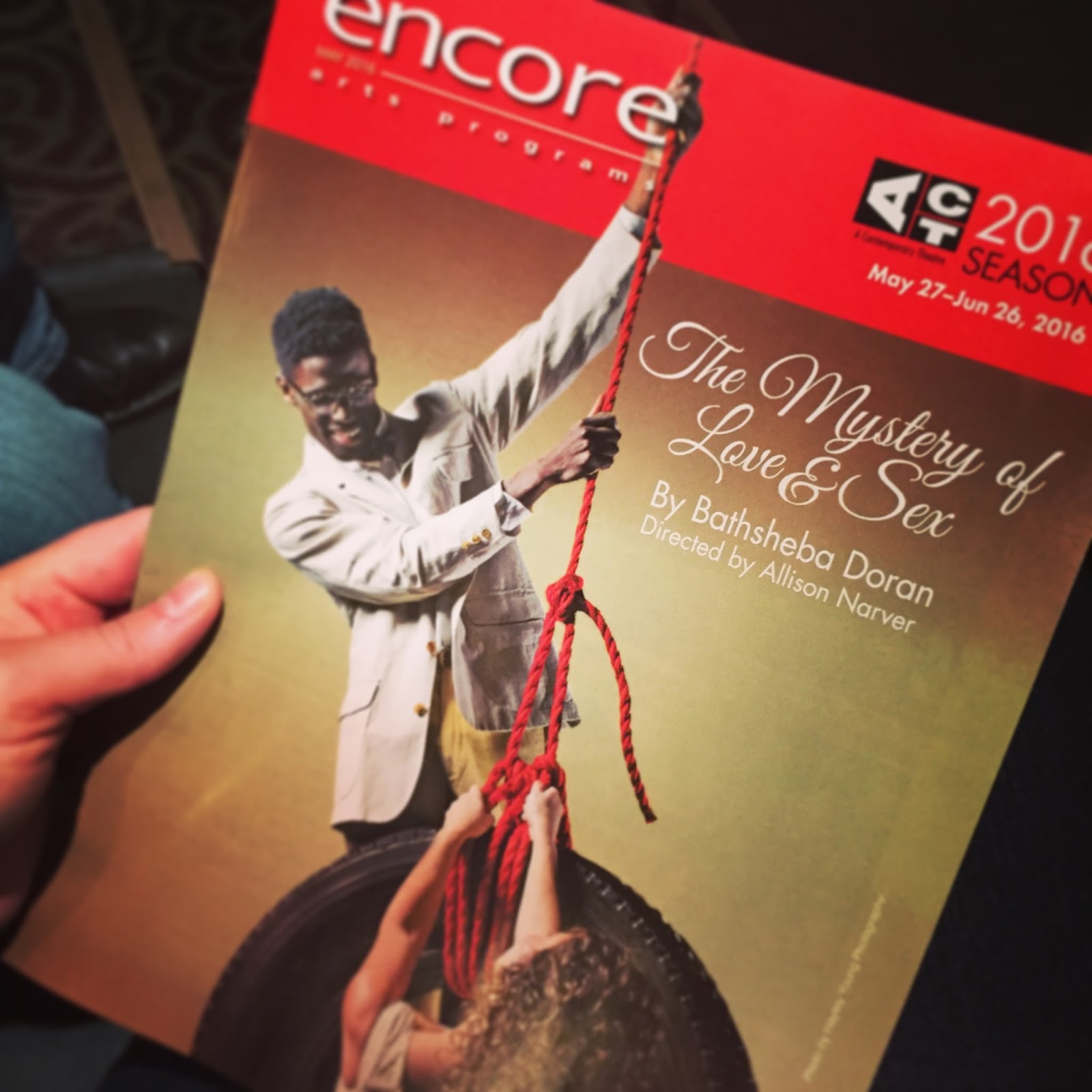
Theatre: ACT in Seattle
Tickets: ACTPass Membership
Date & Time: Sunday, June 19th @ 7pm
One of the things I've been told I need to do with these is to lay out my expectations of the show. In that vein I must divulge that I went into this show a little unsure. This was the show that was labeled "bubblegum" by a colleague a few weeks ago. I tried to go into this viewing with an open-mind, but that critique was there and to pretend it wasn't is a disservice. Keeping that in mind:
Overall, the show was good. Despite being three weeks into the run and the last night of a long week of shows, the energy of the cast was there. I was wholly impressed with the commitment to the characters on stage by the actors. I'll admit I spent an unnecessary amount of the first act trying to remember that I'd just recently seen Emily Chisholm in Outside Mullingar at The Rep last season. But I tend to obsess over things like that until I can re-read the program looking for an answer.
Since I chose to lead with the assessment of the energy of the piece, that might point to whether I, too, imagine it to be bubblegum. To be clear, the explanation of bubblegum theatre is: "Sure it has flavors of racial struggle or LGBT oppression or meta-theatrical-revolution. But then you chew on it for a couple hours, it loses all flavor, and it ends up being tossed out with the program." I found myself saying to my husband at intermission, things felt too superficial. There were so many issues being tackled by the play--race, religion, sexuality, politics, socio-economics, gender roles, etc--that no one thing felt, at that point, to be given enough attention to feel worthwhile. I still felt that way at the end of the show, my opinion countered with the observation that, well, isn't that life? Do we actually spend every waking moment dealing with one or two BIG issues or are they all converging at the same time, bouncing off of one another, and changing with every passing moment and interaction? True. And perhaps it's my cynicism, but I want theatre to gob-smack me a little bit more and not feel so nicely tied up in a bow at the end.
And here's an important thing to ask: Am I the intended audience for this play? Or is the intended audience your average person who makes their living outside of the arts and who might, in fact, not question gender and sexuality politics on a daily basis. The average person who needs to unpack their feelings about being titillated by the nudity of the young female character in Act 1 but feeling like the nudity of the young man in Act 2 is gratuitous. Maybe the average person who thinks it's unlikely that both young characters explore homosexual relationships and have no interest in exploring a heterosexual relationship with one another. Etc.
No, I'm not really the intended audience member. The goal of this production is not to wow the theatre artists in the room. If it had been the set probably wouldn't have been such a simple answer to the many locations called for in the play (6, if you're counting, ranging from dorm room to backyard). It was elegant and effective and I think quite well done, but it was, for me with my set designer hat on, a little too static (despite multiple moving pieces). If it had been about the theatre artists in the room, they probably would not have used the door sound effect that I've heard in other productions in the Allen Theatre because for some reason when an actor walks into the vom* we won't intuit they go through an imaginary door in the imaginary walls unless we hear the sound of it open and close. Really, if it had been about the theatre artists in the room, would the play have been presented at all? Or, if it had, would it have been done in a post-apocolyptic, gender-bending manner that so many theatre artists employ to inject something into your average play? Maybe. Maybe not.
So again, the play was good. I laughed. I thought some things (often quickly brought out of deep thinking by the jokes). I even teared up at the end thinking of the meaning of friendship as the bow was tied nicely around the story. However, it isn't going to stick with me long term and maybe that means it's bubblegum. Or maybe it's just a production that exists. I feel neither robbed of my evening nor galvanized to make changes in the world at large or in my small circle of relationships. I could take it or leave it.
And, readers, that's not okay.
Leaving aside my feelings about the aesthetics of the show because, let's be honest, I picked apart the Tony-winning costume design of Hamilton so clearly I'll critique anything, the play itself should move me. I'm still a person who is married; who has questioned her sexuality; who is navigating the building, destruction, and definition of friendship; who has divorced parents; who went to college; who who who who who.... I am seeking, as implied by the title, to solve the mystery of love and sex. For me to have this "take it or leave it" feeling about the play just as an audience member, well, then I, as a theatre-maker, ask: "Why?" Why spend the resources to put that show up? It checks a lot of boxes: contemporary female playwright, diverse cast (25% is black!), dealing with Big Issues of the day (LGBTQ, race, religion, gender), and strong female characters to name a few. But a production should do more then check some boxes, which, when all is said and done, is about what this play has accomplished. Perhaps that's harsh. But let me leave you with this last observation: 35-50% of the house last night was empty and a noticeable amount of people left at intermission. Ticket sales, my friends, are hard to argue with.
And now, some stats:
# of Actors: 4
# of Female Characters: 2
# of Non-white Characters: 1
# of Artistic Team Members Listed on Title Page of Program: 10
# of Female Artistic Team Members: 5
(including: Director, Costume Designer, Production Assistant, Asst. Lighting Designer, & Dialect Coach)
---
*vom: short for vomitorium
And here's an important thing to ask: Am I the intended audience for this play? Or is the intended audience your average person who makes their living outside of the arts and who might, in fact, not question gender and sexuality politics on a daily basis. The average person who needs to unpack their feelings about being titillated by the nudity of the young female character in Act 1 but feeling like the nudity of the young man in Act 2 is gratuitous. Maybe the average person who thinks it's unlikely that both young characters explore homosexual relationships and have no interest in exploring a heterosexual relationship with one another. Etc.
No, I'm not really the intended audience member. The goal of this production is not to wow the theatre artists in the room. If it had been the set probably wouldn't have been such a simple answer to the many locations called for in the play (6, if you're counting, ranging from dorm room to backyard). It was elegant and effective and I think quite well done, but it was, for me with my set designer hat on, a little too static (despite multiple moving pieces). If it had been about the theatre artists in the room, they probably would not have used the door sound effect that I've heard in other productions in the Allen Theatre because for some reason when an actor walks into the vom* we won't intuit they go through an imaginary door in the imaginary walls unless we hear the sound of it open and close. Really, if it had been about the theatre artists in the room, would the play have been presented at all? Or, if it had, would it have been done in a post-apocolyptic, gender-bending manner that so many theatre artists employ to inject something into your average play? Maybe. Maybe not.
So again, the play was good. I laughed. I thought some things (often quickly brought out of deep thinking by the jokes). I even teared up at the end thinking of the meaning of friendship as the bow was tied nicely around the story. However, it isn't going to stick with me long term and maybe that means it's bubblegum. Or maybe it's just a production that exists. I feel neither robbed of my evening nor galvanized to make changes in the world at large or in my small circle of relationships. I could take it or leave it.
And, readers, that's not okay.
Leaving aside my feelings about the aesthetics of the show because, let's be honest, I picked apart the Tony-winning costume design of Hamilton so clearly I'll critique anything, the play itself should move me. I'm still a person who is married; who has questioned her sexuality; who is navigating the building, destruction, and definition of friendship; who has divorced parents; who went to college; who who who who who.... I am seeking, as implied by the title, to solve the mystery of love and sex. For me to have this "take it or leave it" feeling about the play just as an audience member, well, then I, as a theatre-maker, ask: "Why?" Why spend the resources to put that show up? It checks a lot of boxes: contemporary female playwright, diverse cast (25% is black!), dealing with Big Issues of the day (LGBTQ, race, religion, gender), and strong female characters to name a few. But a production should do more then check some boxes, which, when all is said and done, is about what this play has accomplished. Perhaps that's harsh. But let me leave you with this last observation: 35-50% of the house last night was empty and a noticeable amount of people left at intermission. Ticket sales, my friends, are hard to argue with.
And now, some stats:
# of Actors: 4
# of Female Characters: 2
# of Non-white Characters: 1
# of Artistic Team Members Listed on Title Page of Program: 10
# of Female Artistic Team Members: 5
(including: Director, Costume Designer, Production Assistant, Asst. Lighting Designer, & Dialect Coach)
---
*vom: short for vomitorium


