Sunday, May 15, 2016

Gesamstkunstwerk: The Total Work Of Art

The Flying Dutchman @ The Seattle Opera, 2016
Directed by Christopher Alden, Set & Costumes Designed by Allen Moyer, Lighting Designed by Anne Miletello

Last night I had the pleasure of going to see The Flying Dutchman at Seattle Opera. At times both awe-inspiring and sleep-inducing (specifically when the super-titles go out during the Third Act and you can't understand German), the production was just what I needed.

I began my love-affair with opera in high school, taking part in Seattle Opera's education program that brings high school students from area-schools in to see dress rehearsals of the productions. I found this opportunity late in my high school career, because it was, oddly, administered by our Latin teacher and senior level English teachers. However, as a theatre student, the opportunity to see the scale and scope of opera was eye-opening and as much a pivotal point of deciding to be a scenic designer as anything.

Not surprisingly, my exposure to opera trailed off while in school in Iowa, but was reawakened when I moved to Dallas, Texas and took up a part-time job in the box office at The Dallas Opera. As a part of my work in the box office, I was encouraged/required to attend dress rehearsal performances of the shows in the season. The first production was Verdi's Macbeth, directed by Bernard Uzan and designed by Robert Israel. Interestingly enough, a new production that premiered the year before at Seattle Opera.

Paying witness to the entire 2007-08 season at The Dallas Opera played an important role in shaping my design aesthetic as well as reminding me how much I wanted to be designing. The term Gesamstkunstwerk, popularized by Wagner to explain his aesthetic ideals, translates to "total work of art", "ideal work of art", "universal artwork", "synthesis of the arts" etc. Wagner in particular used the term to explain how all art could be unified through theatre in his essays "The Art and Revolution" and "The Art-Work of the Future". More than Wagner's (and subsequent aesthetes') use of the term to speak about control as an artist, this philosophy appeals to the artist in me that loves theatre (and opera) for it's most important and unique quality: collaboration.

Sitting in the audience of Dutchman last night I noticed a few things that only my particular brain would pick up on. The first was the rapt attention paid by a full and age-diverse audience. I've seen opera in San Francisco, New York, Greensboro, Dallas, and Seattle. Last night was one of the more multi-generational audiences and I think that had much to do with the fact that this production, originally devised in 2010 in Canada, brings the opera not only in content into modern times, but also in aesthetics and quality. Compare the above image with the below, from the Seattle Opera's rental page for their 1980s Dutchman.
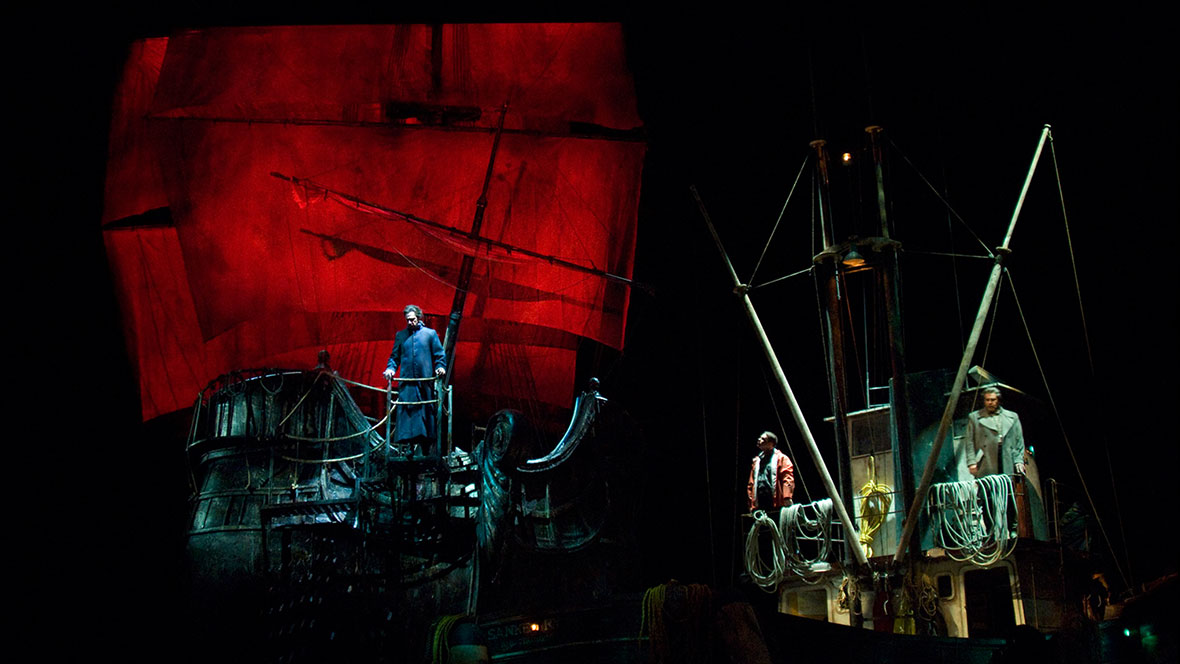

The Flying Dutchman, Seattle Opera 1989/90
Directed by Stephen Wadsworth, Set Designed by Tom Lynch, Costume Design by Dunya Ramicova

The new, arguably Brutalist, set design by Allen Moyer I saw last night is striking, not only because of the dynamic yet sparse use of the stage, but also because that box and the wheel and the staircase are it (plus cameos of some chairs, tables, and a sail). That's both ships, the women's work space, the meeting hall. It is everything. After 2.5 hours I wanted there to be a little more dynamic use of the space. But to the average audience member, the simple nature of the space on stage allowed for the sung-story to take center stage, which, in turn, allowed for the emotional turmoil of the characters to be a stronger point of reference than many traditional stagings of opera allow. Furthermore, a simple design like that encourages the audience to play an active part in constructing the visual narrative of the space. It commands imagination. And, the creative team's choice to do that means that it trusts the audience not only to fill in those visual blanks, but also to be a part of the evening of storytelling in a way that, I'd argue, otherwise makes opera feel stuffy and flat to a generation that suckles so heavily at the teat of Hollywood. It expands the collaboration of the the art form to include the audience. It is a more total work of art.

Working part time at The Dallas Opera and other Dallas-area theatres, many of the traditional theatre people thought I was working on the productions at the opera and they scoffed at the "opera people" and the aesthetics of opera. I rarely corrected them, but I did talk about how exciting it was to sit in the dress rehearsals and see such grand designs. My excitement fell on deaf ears. Designing for opera exists, in live performance, at the pinnacle of little-to-no budgetary and scale constraints, which is generally why productions go into the vault to be rented out or revisited so often. Unfortunately, the recycling of past productions has also bred an expectation among a segment of opera patrons for "traditional" and "classic" designs. (I spoke to many TDO subscribers who were not fans of the 2007 Macbeth we'd brought from Seattle because of it's, also, Brutalist/modern design.)

In turn, the expectation of recycled performances bleeds out into the lay-persons perception of opera. Because it's not only the designs that are recycled. Often it is the staging and the impulses behind the show. Any performer can tell you that replaying the same thing over and over again is a monumental hurdle to overcome when trying to breath life into a character. Add onto that the language barrier that usually exists when viewing opera and, well, a night at the opera can feel tedious, maybe even deadly. This attitude towards opera is only magnified when dropped into a den of theatre people who already have Opinions about theatrical form and what is "worthwhile" on stage and off.

My point, however useless as just a freelance designer in Seattle, is that the poor opinion of opera (specifically by theatre practitioners) is really misplaced. As evidenced by the positive response across a multi-generational opera audience as seen at The Flying Dutchman last night, there is a desire to see new and innovative work. But, more importantly, there is much that even older productions can teach designers. I think back on the production of Faust I dragged a poor, unsuspecting date to at San Francisco Opera in 2010. It was a very traditional design and staging. It was hellish (pun intended) to sit through the three hours of the production and stay awake. However, the style of stage design that uses forced perspective as well as a heavy-handed color-coding for costume design is what I'd read about in the history of theatre design. To have the opportunity to peek back into working history, on occasion, is a reminder of where we've come from as a field of art and, thus, where we need to keep going.

I hope that more new productions of contemporary and older operas are developed by opera companies across the country. I think about the excitement around developing Moby Dick, which premiered 2 seasons after I left The Dallas Opera. The newness about it, though an old tale, breathed new life into the opera companies that have chosen to produce it. It got people in the door to not only see what a newly written opera looked and sounded like (in English!), but also suggested that the art form was maybe not dying after all. And, not unironically, I hope that it will get recycled in a city near me some time soon so I can see a live performance of it.


Tuesday, May 3, 2016

Are Musicals Trying to Kill Me?

South Pacific @ Seattle Musical Theatre
I had a wonderful meeting with a Producing Artistic Director yesterday who is considering me as a designer for his next season. As is the case in many of these meetings, I was asked to talk in-depth about the process of one my most recent projects. Given that it just closed, the topic at hand was my costume and co-scenic design of South Pacific. More than just a conversation about how it went, I was asked a question I've been asked by many non-theatre people: How did I manage to do a show with so many costumes with such a small budget, no help, and a tiny stipend? Well, most non-theatre people ask simply, how do you do that? But behind both questions is the same implied question: Are you crazy?

My husband, who has seen me through five years of freelancing as a scenic and costume designer, has, on numerous occasions, questioned my sanity when I tell him about a costume design I've been offered. He knows, as a former pit musician, that musicals are not small. He also knows, as the poor soul that has yet to have a dining table to actually dine at regularly since meeting me, the work needed to costume 10-30 people in multiple, dance-worthy costumes is no small feat. And he has, on more than one occasion, tried to talk me out of certain projects because, he says, the work I do on musicals might kill me.

But the reality of the situation is that while musicals can be deadly theatre, they are not actually out to kill me.

Musicals, like any show, require organization and communication. If those two things are in working order, death is not a given.

Organization is in the hands of the designer. I read the script, I create character and costume plots, I make lists, tables, graphs, on and on and on. Organization is at the heart of any successful completion of a project. Even those artists that are messy and scatter-brained have an organization somewhere in their head. Often, though, because bringing elements of a theatre design (be it lights, costume, or scenery) from idea to fruition is not only affecting that artist, many theatres have shops and staff and assistants that help keep those artistic souls on task, or at least organized, despite themselves.

When you're a freelance designer at the community or fringe theatre level, you're often on your own. Especially if you're the costume designer. Rarely do companies have costume shops anymore, or if they do, they're not staffed. Here, use this space to sew, by yourself, in the wee hours of the night, if the machine works...? So, organization is key. Part of being organized is time-management and budgeting for the show. Again, in (more) professional theatres, designers are not responsible for these. As a freelance designer, it's a one-woman show. As any work-from-home-type will tell you, a schedule is key to getting up and doing your job every day. I can't tell you how many times I've squeezed in an hour or so of sewing in my PJs before heading off to my day job because, if not then, when? And when it comes to budgeting for the show, well, that's just common sense. Keeping track of expenses as you go allows you to manage your expectations as new ideas come from your director. But, more importantly, it either keeps you off the hook in accounting for the money you were advanced or keeps the company on the hook for reimbursing you. Be it a show of thirty or a show of two, organization is how I, as a designer, can manage any given project. Part of that organization is being able to accurately manage incoming project requests. Can I actually pull of a 25 person show in 2 weeks? Not unless you pay me enough to take a leave of absence from my regular job. Etc.

And now that you're ready to quote Robby Burns at me with "The Best Laid Plans...", I did mention another piece that was required: communication. Say it with me: COMMUNICATION. Unlike organization, this is not solely in the hands of the designer and this, my dear friends, is what is like to stab you in the back and kill you dead while working on any show.

A designer can do her due-diligence in this department by attending all production meetings, responding to all outstanding requests, asking questions about things that need to be asked, send e mails, warn producers the show is going over budget, contact the stage manager when actors don't show up for fittings, publish inspiration boards for the entire cast, etc etc etc. A designer, however, cannot force the director to respond to her e mails about character tracks for the ensemble. Or the stage manager to send out rehearsal reports. Or the choreographer to answer questions about dance shoe needs. Or the accountant to send a budget advance. Or the production manager to make keys available to stock. And the list goes on. These are the things that make designing a show with no shop, no assistant, no stitcher, no dresser, or no help apt to kill you. Or me, as these are all things I've experienced, often on the same show. And, on a musical, where the demands on costumes can be exponentially greater due to choreography, blocking, and, so often, the scope/time-period of the story, these little communication issues start to magnify really quickly. So quickly.

So when asked how/why I keep costuming musicals with the implied whisper of "you're crazy", my response is often this: I am good at what I do. Musicals are by no means my favorite genre to work on and I welcome a nice one-era, afternoon at tea drawing room show. However, when you've proven yourself a master of 75% of the mathematical equation of costuming a show (let alone actual design skills), you're going to get called back because the producers can tell when things fell through because of a disorganized, non-communicative designer or some other piece of the puzzle. Musicals also pay well because, hey, they are a lot of work. Now, when you find me taking on another musical for less than a grand without any help, then, honey, crazy and likely to die, I am.

Wednesday, April 27, 2016

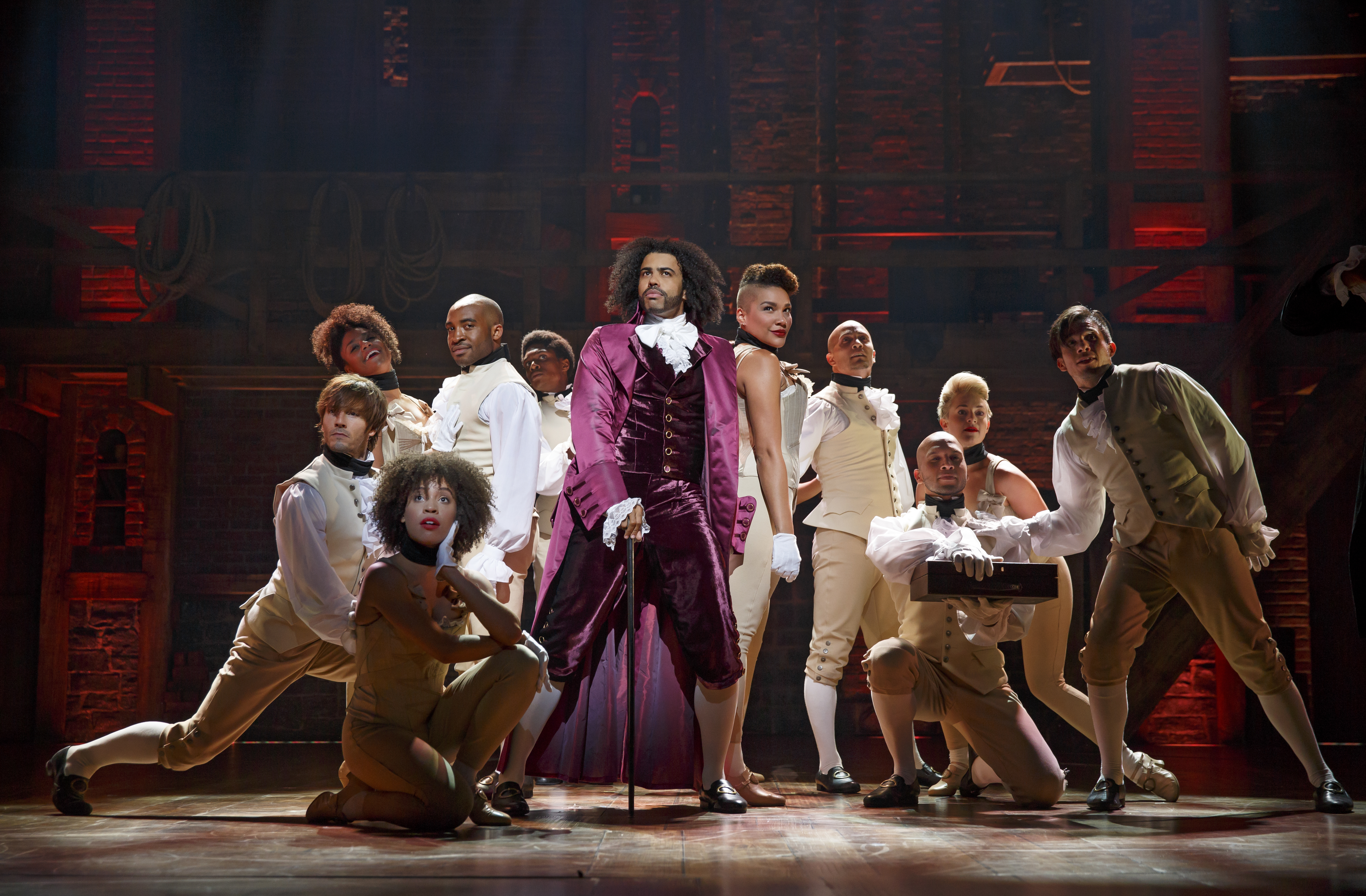
Musings on Hamilton

Go Listen to the Pop Culture Happy Hour Podcast about Hamilton. Do it. I listened to it on the plane ride home and I was nodding along to it the entire time. It's nice because they have a musical nerd and a rap nerd and then normal people. It was a pretty perfectly well-rounded discussion that hits it on the head.

One of the questions I had to answer for myself when my husband and I decided to plan the trip and buy tickets on the orchestra level, was why it was important for me to see the show in NYC, on Broadway, with as much of the original cast as possible. I am pretty sure that my desire comes from both a place of fandom as well as a theatre-maker. As a fan, being able to see the people responsible for the show in the flesh was beyond words. When Lin-Manuel Miranda walked out on stage, the entire theatre erupted in joy, myself included. We knew he was going to be on stage (the program tells you who is performing that night and no other announcements about understudies or swings was made), but it was still pure delight to actually see him. To know that he was going to spend the next 2.5 hours with us sharing his precious musical with us. Truly amazing. Of note, we were fortunate to have the entire original cast perform on Wednesday evening except for Jonathan Groff because he recently left the show and a new King George III (Rory O'Malley of Book of Mormon fame) had been brought in recently. There really aren't adequate words to explain how cool it is to see the people who you've been listening to for months as disembodied voices. It really is the most amazing thing.

In the podcast, they use the word "kinetic" to describe the show. This is a very apt way of explaining what is, for lack of a better term, missing when you listen to the cast album. I'll admit I don't have a ton of recording-to-live experiences to draw upon, but I'd wager Hamilton's particular staging and choreography are in fact very special. The soundtrack tells you the story, you get the wit, the brains, the allusions to musicals and hip-hop/rap styles, and the beautiful music and arrangements. But that's only a part of what makes up musical theatre. The choreography, the blocking, the interactions between characters, the space, the costumes, the lighting... that's what you don't get until you're sitting in the Richard Rodgers Theatre, in the room where it happens.

As a designer, in my opinion the creative team pretty much nailed it. I'd say that the set isn't super special, but it is perfect for the show. It isn't a revolutionary set design, it is form following function, and also pretty to look at. It will be interesting to see how it changes for the tour. While not necessary, the nested turn-tables play a large role in how the show is blocked and how the furniture, which makes each different scene, is moved to and from the wings. For that alone I'll want to see the national tour. However, since the pictures started to come out from The Public, I've had some issues with the costume design. Overall, again, it's a form following function thing. It's pretty, not flashy, it tells the story. The mixture of period costumes with natural hair has grown on me, but sometimes it feels like it falls a little short of being more of a workshop feel vs. a fully realized play. I don't know how I'd have done that part differently, but it is ... something that makes me pause in heaping praise on the costume design. The thing that bugs the crap out of me in regards to the costume design is the ensemble, specifically the women. They had two base costumes:

one that mimicked the male ensemble, with waistcoats over their leggings and with boots
one that had them wearing corsets over their leggings, with high-heels

I get it. It's a way to allow the women to be women in some scenes (crowd scenes, Thomas Jefferson's staff, etc) and still be able to dance. An when they are wearing just the waistcoats, they're soldiers. In this costume, gender is erased from the narrative the way that the casting erases race. Cool. Totally get it. HOWEVER, women in leggings and a corset is ... sexy? It feels more incomplete than the male costumes. It looks more like they are wearing underwear and the guys are all wearing clothes (notice how the men now have shirts on under their waistcoats and we're not seeing their muscle-y, dancer-arms?). It's a small thing. It's a nit-picky thing, but it's also the thing that really shows that the entire creative team is male. And, to be sure, we don't know that Paul Tazewell (costume designer) didn't try something different, but... the final product is allowing the male gaze into the conversation when, in other places, gender is neutralized. So, that's my one complaint that, even seeing the entirety of the costume vision, still remains.

And, I'm going to dedicate an entire paragraph to tell you how the lighting design was one of the best parts of the entire show. Musical lighting is an entirely different beast than doing design for a regular play. It lives in this place that straddles reality and rock show. And this lighting design does just that. The entire ceiling of the stage was solid black with lighting instruments. Usually musicals are pretty light-rig heavy. However, I've never been in a space where I've only seen lighting instruments. In part because many other musicals rely on things flying in and out. I think the only thing that flew in were lanterns. So the lighting designer got to use up the air for all kinds of moving lights, LEDs, specials... the works. And DAMN, he deserves to win the Tony, no questions asked. When describing the aim of lighting design, it is often described as "painting with light." Using light to evoke mood, place, time of day, and enhance the physical world is a tall order. For the most part, as a designer, you want your design to support the story but not be visible. Something the audience appreciates -- hey, I could see their faces or hey, that sunset on the back wall was pretty or hey, when Sweeney Todd slit their throats, the red lights helped heighten the drama -- but for the most part isn't really its own character in the story. And that's not because it can't be but because it's really, really hard. It's better to aim to be a supporting, unobtrusive character because if something goes wrong (the actor misses their cue/light or the cue is called in the wrong spot or, heaven-forefend, the instrument doesn't work) it won't be noticeable. And then there are shows on Broadway in which the lighting design is more rock show than just lighting their faces. Hamilton is one of those and so much more. The designer very much painted with light. During the songs where the hurricane in Hamilton's life is evoked: there was a hurricane on the stage floor. When Hamilton is walking when it's "quiet uptown" those same lights made cobblestones for him to walk on. When Hercules Mulligan jumps out in his solo song and when the Marquis de Lafayette sings his song and when Burr sings "The Room Where it Happened" the lights were bouncing all over the place and would give a BeyoncĂ© show a run for its money. AND IT WAS PERFECT. Perfect. Not too much, not too little, but magical and a way to direct focus and enhance the story. If this was what I was told lighting could do before I started down the road as a scenic/costume designer, I'd have more seriously considered lighting design. That's how amazing the damn thing was. (AND, let's not forget, that the reason it worked was because the stage manager did an amazing job calling the show and the cast hit their mark, EVERY SINGLE TIME.)

Lastly? I have to speak to the ensemble nature of the show. Arguably, typical musical structure really exists as a star vehicle. There are solos for the main characters, supported by the ensemble, then they leave the stage, the story is advanced with some big, flashy ensemble numbers, and then the stars come back on and sing, etc etc. This show doesn't do that. From the cast album you know that Leslie Odom, Jr. as Burr sings most of the show as the narrator. That's unusual to have one person carry both the narration and an actual character story line so exclusively. Listen to the rest of the show. Renee Elise Goldberry as Angelica sings the beginning of "Quiet Uptown"... why? It's moving to have Angelica sing that song about her sister and brother-in-law, but it's not necessary as part of the story, really. You have a sense when you listen to it that there is an ensemble nature to the performances, but when you see the staging, you see how the director has characters not in the scenes pay witness by being on the balcony of the set and in the wings, watching. It's a small thing, and again, most lay audience members aren't really going to get it on a conscious level. But they're going to have a sense that the telling of the story belongs to everyone on stage. Especially with the picking out of ensemble members to play the small but important parts: Charles Lee, Sebring, and George Eaker (they guy who duels with Phillip Hamilton). Those are ensemble members who dance and sing their asses off THE ENTIRE SHOW and then KILL IT in these parts. This is all a part of the nod to the over-arching theme that LMM is playing with right in the middle of the show: "You have no say who lives who dies who tells your story." Or, in the opening song when the cast sings "We're waiting in the wings for you." The breakdown of the fourth wall is there, subtly, but there to remind us that we're not watching a period drama about our founding fathers, we're watching talented, diverse people of the twenty-first century celebrating the life of a man who we've nearly forgotten using the tools we have now.

The ensemble nature of the show is related to the little lines in the album that some people have nitpicked. Three examples: When Hamilton says "That's true" after the tidbit about how Martha Washington named her feral tom cat after him. When Jefferson says "Don't act surprised you guys 'cause I wrote 'em" after he references "Life Liberty and the Pursuit of Happiness" during "Cabinet Battle #1". And when Adams says "Which I Wrote" after Jefferson (?) mentions the Bill of Rights a scene or two later. They all feel a little weird when you're just listening to them out of context on the album. But when you see how they are delivered to the audience (in the case of the first one), to a cast member who is just off stage with no lines (the case of the line from Adams), and a combo of both (in the case of Jefferson), you see, I'd wager, the evolution of the show through being performed by living breathing, talented actors. I can't say (maybe it is clear in the book that just came out about the process of writing the show), but I'd say these are examples of how the final script is often created in workshop and performance because, hey, theatre is not just what's written on the page. Theatre is an alchemy of the collaboration of so many artists coming together to tell a story and that is what makes it special and important as an art form. And that, specifically, is how Hamilton has become the phenomenon it is. When you read the articles and statements from artists about Lin-Manuel Miranda, from the beginning of his career with In the Heights, the guy is generous and humble and welcomes people in to his process from beginning to end. And he's brilliant with words and music and form and everything.

In the podcast that I linked to above one of the people mentions that sometimes she gets annoyed with the overwhelming response to the show, how it has become such a huge, commodified cultural phenomenon that exceeds what most theatrical turning points (Rent, The Lion King, etc) have been granted by the world. It can be annoying, but then she reminds herself that it's giving power to people like LMM and Leslie Odom, Jr. and Daveed Diggs and Renee Elise Goldberry and and and for their next project. It's gilding them with praise and granting them a place in cultural history that transcends Broadway and theatre and will propel them, as amazing artists and, more importantly, generous souls to help change the world we live in. And that is what makes all of this so incredibly exciting to be a theatre-maker during the time of Hamilton.

Sunday, October 19, 2014

So Fresh & So New

I'm back. In Seattle. Writing this blog.

The last entry I posted still had me working at the San Jose Rep box office and freelance designing. For those of you unaware, SJ Rep closed earlier this year due to budgetary issues. I left a year before, but it still hit hard. More on this later.

After moving on from SJ Rep, I freelanced exclusively with a few on-the-side jobs like Starbucks and production management. And then I began work at Aurora Theatre in Berkeley. It was a stretch for me to commute to, but the best decision I've made about full-time employment. More on this later, too.

But just a month ago we made the move to Seattle, a decade-long dream of mine since leaving for college. When my parents moved from Seattle to North Carolina just before I graduated from Grinnell, I was so disappointed I wouldn't be able to move back to my hometown and be a part of theatre where my love of the art began. In retrospect, the journey I took instead--Portland, ME to Dallas, TX to Greensboro, NC to the Bay Area--broadened and deepened my understanding of theatre in this country and my role as a theatre-maker here. Now that I'm back in Seattle, I'm pumped and prepared to do so much more than if I'd come fresh out of college.

Now, after 18+ months hiatus from this blog, I'm also prepared to put the proverbial pen-to-paper to start talking about how I view theatre and how it can be better. When I began this blog I just wanted to write intellectual things and challenge myself to write more. That hasn't changed much, but I also want to open up the conversation. With four years of professional work under my belt in a vibrant, amazing theatre community, I have returned to a theatre community that is near-and-dear to my heart but also seems to be in trouble.

Within the first week of arriving in Seattle, Balagan Theatre, the darling-child of the mid-sized theatre scene in Seattle closed amidst very unhealthy financial practices. The closure has been covered nationally. And I encourage you to read-up because there isn't much need for me to rehash it here.

A short time later, Mike Daisy's article "The Empty Spaces" was republished in The Stranger (original publication was, reportedly, in 2008). The article struck a nerve and I expect it was re-released to coincide with the questions floating around the closure of Balagan AND Mike Daisy's performance at CalShakes earlier this month. I actually found the article, not through any Seattle channels,  but through industry friends in North Carolina. We, as the younger generation of actors and artists coming up through theatre are struggling because, as Daisy says, theatre in America is the place for administrators not artists.

Oh, yes.

Because I work as an admin again and my art is on hold as I get my foot-hold in this new community. And it hurts my heart and makes me sad. BUT! I'm not going to sit idly by. That's what resurrecting the blog is about. I've struggled for the last 18 months about wanting to write about many things but felt too afraid of getting myself in trouble because the community is small. I know I run that risk now, but I can also talk about things that I learned in the Bay Area, now removed from it, that don't run the risk of destroying my professional life. And, damnit, there has to be a way to be critical without pissing people off.

Well, here goes.

Thursday, January 31, 2013

Keep on Keeping On

Every once in a while I think, hey, I should write about that on my blog/in my journal/to my friends. Rarely does this occur where I can immediately act on the impulse (generally it happens in my car while stuck in traffic, mulling over the day). So, yes.

I don't have any illusions about becoming an amazing blogger. At this point there isn't much that I'd put out into the world that would interest anyone beyond my immediate circle of friends. Nevertheless, I don't want to say the blog is dead. In fact, I seem to get quite a few visits to my post about prop money so maybe I'll do more How To's. Who knows.

But for now, things are changing. CT and I are married. WHAT?!? Yes, married. It was a great ceremony at my step-mother's house in Chapell Hill, NC. Very small and simple. Still expensive, but good. We're anticipating a move closer to friends and San Francisco. So, woo.

More to come, I hope.

Wednesday, September 5, 2012

Pericles or How I Learned to Stitch

As promised, an entire blog post dedicated to my design of Shakespeare's lesser known play, Pericles, at Shady Shakespeare this summer.


The summary of the story is that King Pericles goes on a journey to find a wife and ends up visiting all kinds of strange lands. The director for this show, Shady's resident dramaturg, had been working on the concept of Pericles being set in space rather than the Mediterranean for seven years, and finally it came to fruition in this production. Each land Pericles encounters represented  a sci-fi/cult-classic/other planet from many well-known movies and TV shows, from Flash Gordon to Star Wars to Mortal Kombat.


I became the Costume Designer for this show after the concept had been fleshed out in design meetings. And while I did create the sketches and make some artistic decisions, I cannot take credit for much of the over-arching concept of what lands would be represented and by whom. The whole thing was an adventure that rivaled the epic story Shakespeare wrote.


Pericles' home planet of Tyre was that of the venerable Star Wars Jedis. He wore the many-layered Jedi tunic, obi, shoulder armor, and robe. And his most trusted advisers were modeled after very iconic Jedis from the many movies.

He visits the land of Ming the Merciless as well as a Klingon planet.


As you can see, the costumes were the most important part of telling the story of where Pericles journeyed--the scenery was a unit set and had only a few elements that changed.

Perhaps my and the audience's favorite part of the entire show was the lightsaber fight.

Yes.

Lightsaber.

Fight.

Each Knight was a different kind of sci-fi character, much decided by the actor themselves.

From Left to Right we have: A Tron-ish, Mandolorian-ish fighter; A White Samurai; A Darth Maul-ish Character; A Matrix-inspired Fighter; & Our lady fighter in a bit of goth mixed with Tron.
I'll leave you with one more image that needs no explanation.


Please visit my website for more!

The project was eventful and hard. The performance space was in the Sanborn County Park in Saratoga, and so everything was remote and out of the way. I'm sure I shouldn't assume all summer stock Shakespeare will be like this, but I don't know if this kind of work is really for me. In the end I did 10 loads of laundry and took pounds of dry cleaning to the cleaners.... Can't wait to put this all behind me.

Saturday, September 1, 2012

Radio Silence Over

You know how it is, you put something off for so long that getting back to it becomes harder and harder. Especially as a blogger, where do I begin in the time that I've been away. How long do I push the rewind button?

So much has happened.

I finished up the drop I last wrote about and never got any kind of production photos.

I supervised the costumes for Broadway By the Bay's The Marvelous Wonderettes and taught children at Pied Piper Players's inaugural summer camp.

Teaching children about theatre is the most rewarding, and I had my first experience working with a child with Asberger's. It was a challenge, but I felt very good about how everything went.

This is the cast and staff of Charlotte's Web. I love this picture of everyone and you can see the awesome backdrop the kids designed and painted!

And our small but mighty cast of How to Eat Like a Child. You can't see it here, but they also designed and painted two legs. This was a great group.

Possibly the most exciting bit of work I did this summer was a design for Pericles at Shady Shakespeare Theatre Company. I have some great images from that show and will be uploading them in a blog post all their own.

So, this summer was a success in the freelancing world, although I nearly dropped dead the week that Pericles was teching and we were finishing up the second session of camp. I've got some fun projects on the horizon, most notably working on BBBay's A Chorus Line and a few actual designs. I'm also going to try to get back to blogging. No more excuses because we're all caught up!

Oh, also of note: Working on my biggest design yet: My wedding!!!