Friday, November 16, 2018

My Mouth Cost Me Work: How, Why, and What Next

My partner sometimes calls me mouthy. It's an endearment, before you get the wrong idea. And refers to the fact that I don't really know how to play the politeness game when it comes to speaking my mind about the injustice inherent in the theatre world. See previous blog posts here and here.

Recently, this mouthiness lost me a scenic design opportunity with a midsize theatre company in Seattle. (N.B. I'm not sure if my definition of midsize is your definition of midsize... so the operating budget just passes $1 Million. In comparison, A Contemporary Theatre [ACT] has an operating budget of around $7 Million).

I am intentionally not naming this organization.

The point of this blog entry is not to cry foul and point fingers at a specific organization. I want to talk about (1) the thing that I was "mouthing off" about, (2) how my privilege allowed me to say something, and (3) where the theatre community can go from here.

Ready?

The Thing I Was Mouthing Off About

I posted on the Seattle Theatre Artists and Seattle Technical Artists Facebook groups the following message:

"Asking/requiring freelancers to get a business license to work with your org is a barrier that disproportionately negatively affects artists of color and artists of other under-represented groups. As Seattle Theatre figures out that representation around the table matters, there is a going to be a time where orgs will want to hire a freelancer that isn't making bank on their gigs (due to size & number of projects offered). And an independent contractor does NOT need to apply for a business license UNLESS they meet some specific criteria, most of which don't apply to theatre freelancers (we're not hiring people or selling anything that needs to be taxed). But most importantly, if you make less than $12,000/year, you're not on the hook for a license according to the state. Just food for thought, theatre companies, as you work towards EQUITY and diversity at your organization. (BTW, in 2018 I've made less than $10,000 so far with all my stipends... just to give you some perspective on someone who "works a lot" including stipend-ed production management gigs.)"  (Permalink) (Also, permalink to the convo in the Seattle Technical Artist group)

Whether or not you agree with my choice of words or use of all-caps for emphasis, this is a real thing that is happening in Seattle/Washington State. In conjunction with this post, I also asked questions of the original theatre company that requested a Business License from me, two other theatres that I've worked with or have personal connections at, and my fellow freelance artists. 

What I heard: This is not something that theatres have been asking of their freelance artists. BUT, theatres are also waiting to find out what comes of the audit that the original company is undergoing. (Oh yes, the original company [OC] is undergoing an audit, so this request comes from a place of both high tension as well as lawyer advice.)

I thought to myself, okay, clearly I need to know more about this for myself as a freelance artist in Seattle. And thus I went searching for information about Business Licenses in Washington State. This included looking at it from the side of the person needing to get a license but also reading through the document sent to me by the OC: The Independent Contractor Guide published by the Washington State Department of Labor & Industries. In this document, the employer asks a round of questions about the potential contractor/employee to determine their status. It's really unnerving, I think, to have a theatre company answering questions about whether I have a place of business outside of their organization that I can prove on a tax filing form, among other distinctions being used by LNI.

So I decided to ask LNI directly for some insight. First I ended up in just General Inquiries, then a representative who deals with Workman's Comp Claims in Seattle, then the Small Business Liaison Office, then finally Workers’ Comp Coverage Determinations Office. Apparently, you can e mail a contract to the Determinations Office to have them tell you if you're a Volunteer, Independent Contractor, Covered Worker, or Employee. Take note!

After going over my interpretation of the six questions asked by the Independent Contractor Guide, the Determinations officer advised me that I would be considered a Covered Worker and that the OC would be responsible for paying Workman's Comp and reporting my hours regardless of if I provided a Business License (aka UBI).

Hmmmmm.

This left me with even more questions about what to do as a freelance artist because the fact that a non-profit theatre company in Seattle is being audited (much like the rash of audits in 2005) and changing their contracting policies while other orgs watch... there is a change in the air. And the fact that the individual artists that are going to have to start getting those licenses don't really know what's going on, well, that IS a problem. I stand by what I said in my original FB post, that this requirement -- whether originating from the state, city, or the theatre company -- disproportionately negatively impacts artists that are under-represented in our industry, namely POC, LGBTQ+, Women, Disabled, etc. Access to knowledge about these decisions and laws takes time to get. Advocating for yourself and knowing your rights takes time. Being a freelance artist who barely makes minimum wage on the amount of things we're contracted to do, well, doesn't leave a lot of time.

Needless to say, I'm going to be staying tuned to this and seeing how I can advocate for transparency from our theatre organizations and the city and state.

How My Privilege Allowed Me to Say Something

Do y'all know about white privilege? If not, please pause and go read (just one of many) essays answering "What is White Privilege, Really" you can find on the internet. White people, this means you.

So, I'm white. I have white privilege. My ability to speak up about the impacts of this thing -- that is also impacting me as a white artist -- is related to the fact that my indignation and frustration is less upsetting than if a POC artist took to social media. In our society, people of color are not afforded the same understanding of their anger. Their responses must be milder and less incindiary or face harsher criticism and retribution from our society at large. Yes, even in Seattle. Privilege number 1.

But there is another privilege I lay claim to that opens this door for me (because I'm also a female-passing, queer-identifying individual, so it's not like I'm not a target): I have a day job and don't need the design gig being presented by the OC to survive. I'm not cobbling together my bill payments via my measly freelance checks.

This is not nothing.

I might be an independent artist in the theatre community, but I'm not as vulnerable as many. I can rabble-rouse and, while it still stings to lose the opportunity to design the set at the OC, it isn't going to make or break my life (my career is another story and covered in the last part, below).

Where the Theatre Community Can Go From Here

Again, I'd like to reiterate that the outcome of my Facebook post and educational traipsing through state and city licensing was to be removed from consideration from the job at the Original Company (OC). I spoke about my white privilege and economic privilege that allowed me some freedom in speaking out. But clearly I'm not immune to pushing a hot-button issue to the point of losing work.

And it stings. I'm not going to pretend it didn't. I wanted to work on this show with this director and at this company and on this script.

But more importantly, I'm disappointed that the OC felt so threatened by my posts to drop me from consideration. Which is not how they passed it off to me in our e mail exchange. No, I was originally told that the time it took me to respond to the production manager -- four days -- meant they had considered me uninterested and they had moved on. But that wasn't the whole story. I was fortunate enough to have the director want to continue to advocate for me in a forthcoming phone meeting with the OC. Then the director was made privy to my FB-related dismissal. So, I got to hear the real reason I was no longer being considered because the director had already committed to keeping me in the loop.

#WhyIndividualArtistsDoNotSpeakUp #ButTheyDoSpeakToOneAnother

I don't regret what I said. I don't regret what words I used or my indignation. I don't even really blame the OC in letting me go from consideration (I don't AGREE with it, but I also can see their side of things).

What I can't stand is that we have this very big issue that is about to impact every theatre artist in our community in relation to freelance work -- regarding getting and paying for business licenses and subsequent taxes, whether or how freelance artists are covered if they get hurt on the job, whether they will get paid the same rates -- and we have theatre organizations that are lobbying on behalf of themselves as they navigate this and making decisions and communicating out new policies without much transparency for the rest of us.

Seattle's theatre ecosystem is a mess, and not just because of our lack of representation and diversity on and off stage and the inherent racism that gets played out on our stages under the guise of "progressive plays": we're not really a whole community made up of artists and organizations. Organizations close ranks because they have the resources to reach out to their peer institutions for help and also warnings. But theatre artists are getting the short end of the stick with the lack of transparency about decisions that are impacting us directly.

I mean, in this case alone, it's good to know that the OC isn't cool with me being mouthy. That gives me some really concrete information about where to go from here with that particular company and the artists they work with. But I also don't feel comfortable revealing who this company is because I don't want to create backlash against myself (or the company). The environment here is very "behind closed doors and backs."

But we also have no advocacy in these organizations when we're not represented by a Union -- and so, so few of us will ever be represented by a Union.

Thus, I ask, where can we go from here, Seattle? Transparency. Communication. Heck, if I could have had the opportunity to actually respond to the OC about the issue they took with my Facebook post, well, we could have had a really great conversation. Probably still parted ways because I don't feel comfortable getting a Business License at this point in my career, but again, conversation would have happened.

Instead, I'm out here as an independent artist hoping to educate myself about this law that is impacting me and wondering what other organizations or individuals I have rubbed the wrong way by stating a fact that our government systems are part of a system of racism and oppression.

What's next for me, Seattle? Not going to stop being mouthy, that's for sure. And maybe not going to see another design contract for a while either because I'm too much trouble for y'all or because getting a business license is NOT in my best interest. (N.B. Once you get a Washington State Business License [$19] you'll also need to get a City of Seattle Business License [$45]. Don't listen to anyone that says it's just $20! Don't forget to do some reading about taxes as a business, too.)

Monday, October 1, 2018

Your Gender Politics Cannot End at the Wings: Seeing Richard III at Seattle Shakes

Sarah Harlett as Richard III and Suzanne Bouchard as Buckingham. Photo by HMMM Productions

Last night I went to see Richard III at Seattle Shakes, produced in partnership with upstart crow collective. Last year I saw Part 1 of Bring Down the Housewhich enthralled me, as it did most of Seattle. At the time, my concerns over representation on creative teams was nascent and not fully formed. So forgive me for not having written about this before.

From upstart crow's website:

upstart crow collective was co-founded by Betsy Schwartz, Kate Wisniewski and Rosa Joshi in 2006. We are dedicated to producing classical works with all-female casts for contemporary audiences. Focused on telling story and living characters honestly on stage, our work is text centered and visually imaginative.

What an amazing, admirable mission. Really inspiring for me (user of she/her and they/them pronouns) to read and then absorb their work. Shakespeare has always felt too elite, too wordy, too distant for me. Even when I've designed for Shakespeare, the dated gender politics frustrate me, especially when I'm responsible for clothing the female-identified characters -- often in modern dress -- to fit in with the tropes of womanhood: virgin, mother, whore. So to get the opportunity to take in the power and politics of the histories told by some of the most formidable performers in the area who would not otherwise get to play these lords and princes and kings: awe.

And then I look the production team page.

And my heart sinks.

First, let me be clear that I admire and respect every single designer who worked on this production and really loved their choices and designs. This is not commentary on what was represented on stage by their artistic vision. I also recognized that the same creative team worked on Richard III also designed for Bring Down the House. And that there is great comfort in not having to re-establish visual language and vocabulary when taking on adaptive work that is risky (yes, all female-presenting performers doing Shakespeare will probably always be risky even if you've proven it's amazing).

However... why is the design team still a representation of our male-dominated theatre field? Set designer, lighting designer, co-sound designer.... all  male-presenting if not -identifying designers. Costumes, props, and co-sound designer are holding down the other part of the identity pool, but that's pretty normal for our industry. Check out this HowlRound report from 2015 if you'd like statistics to back this up.

Yes, this frustration about the utter lack of representation at the creative table comes from a selfish place. Let's just get that out there. I see my male-counterparts get asked time and again to do scenic designs and I look at my resume--MFA, Award-winning Designs, GENERAL AWESOMENESS--and ask why not me? And then I get the call to design costumes for that same show and I'm like, cool, my chromosomes dictate where my skill lies.

But this goes beyond me. And gender. While it's easy to be frustrated that theatre, as a field, is lead by cis-het white dudes when you're definitely not checking many boxes in that identity, it's even more angering that, in the name of equity, diversity, and inclusion (EDI) as well as novelty and marketing buzz, theatres are mounting these amazing productions that examine how stories can change, grow, and deepen when the bodies presenting them (aka performers) are as diverse as the population in 2018.

And that is really important.

However, the people who are creating the world of these gender-swapped, racially diverse stories ALSO have to be a part of the under-represented groups. The voices around the table making decisions about architectural angles, ephemeral lighting, and subconscious-gripping sound cannot continue to be (cis-het, white) men if we're truly going to end white supremacy and patriarchal control of our art form.

I look at the production team of Richard III, and my first frustration comes from the male-domination in those creative roles. And then I look on stage and see the choice of director Rosa Joshi to pit the transcendent Porsche Shaw as Richmond, savior of England, against the gripping, equally-talented Sarah Harlett as Richard III, twisted monarch, and I cannot help but see (and feel) the politics of 2018: a Black leader (dressed in white, shout out to the costume designer) standing above the slain White leader (still dressed in black), declaring victory and peace for England.

The conversation expands, knowing full well that the racial and cultural identities represented on that list of creatives are dominated with whiteness.

The set design, along with lighting and sound, create the container of the production. It sets the tone, the visual language, and the boundaries of the world that the story exists in. When producers and producing companies do not consider who is making those decisions -- sure, to be molded by a director who often does sit at the intersection of multiple marginalized identities, but damn that's a lot of burden for one artist to bear -- they are continuing to bound the story by cis-het white male privilege and thinking (and art). It's hidden to the audience, the donors, the media. But not to the performers and the members of the creative community. We see this inequity, we can feel the oppression of decisions that impact our identities (in June 2018, American Theatre Magazine published an article that discussed how the white-gaze plays out in lighting design -- where designers have to light all skin tones).

If we are going to turn a corner as an artistic pursuit, our equity and inclusion politics cannot stop at the wings. We need to infuse our creative teams -- and our admin teams -- with the voices of everyone who resides in our universe in 2018, but specifically with the ones that we haven't been hearing or listening to.

I want to be hired. But more importantly, I want to see the world through intersectional eyes.

Monday, June 25, 2018

My Hair. My Gender. My Identity: Part Three

"How about we stop here and let you live with this length for a bit." The hairdresser who I'd asked to cut off 8"+ of hair in January was nervous. Hairdressers are always nervous cutting my hair, but I think he particularly felt pressure because he is also a friend who had read my blog posts.

Suddenly I had come face-to-face with a reaction to my writing and my journey. And the reaction tested my resolve to make this change. To discard my femininity calling card.

I didn't push further for the hair cut I wanted.

Because I was scared, too.

In part, I was scared because cutting that much curl would inevitably take some time to see what would actually happen with the hair shaft. But also because his concern about such a drastic change, someone who knew what I had thought about and written, and who was having a direct conversation with me about gender identity made me question everything I had resolved.

Which meant that if I had sat down to write Part 3 then, I would have wallowed in my self-doubt rather than continuing to move forward.

Since beginning this writing project, all I could hear in my head was my mother asking "What's the point? Why are you dragging the skeletons out of the closet?" Though she died six years ago, her influence is still great.

And then I was cute again. My Shirley Temple curls, resting at my ears, healthy and very springy, had returned.

I resigned myself and put this thought experiment on hold.

Until this week.

On Thursday, I watched Hannah Gadsby's beautiful, heartbreaking, oh-so-personal piece "Nanette" now available on Netflix. I encourage anyone reading this to watch it, no matter what you think about comedy, the #MeToo movement, or me. Really.

What struck me and had me balling was when Hannah (and yes, I'm going to use her familiar name for many reasons, not least of which is that I feel personally connected to her and I don't want to distance myself by using her last name -- though I recognize the issue with this since most females and female-identifying people are often spoken about like this as part of the misogyny of our world) relays her realization of years of internalizing the message that she was "the wrong kind of woman." And that, even in her later years, that she is the wrong kind of lesbian. And I... can't really put into words how much that broke me open.

In Part Two of this blog series I said my hair is my claim to femininity.

But you know what? I like my hair. I like that it is distinct and different and that people are jealous of it. What I don't like is being called cute. Which I can't do much about apart from aim to not look cute... which then gets rid of this part of me.

--

In 2018, we've caught up with my small liberal arts college peers in being able to discuss and proclaim gender as a social construct. As someone who works in the business of choosing costumes to tell stories and hint at identities on stage, I have long been tapped into ways that we perform and don gender on any given day. But until this year I hadn't really sat down to scrutinize how my trauma and upbringing had been molding my identity and making me deeply uncomfortable in my own skin.

About a year ago I started to adopt the pronouns they/them. I still use she/her, as much out of habit as out of my wish to. In the last few months I've answered surveys that allow me to identify outside of the binary as gender-non-conforming or gender-queer.

And in the past two months I've thought a lot about gender and how I want to not be "gender-non-conforming" or "gender-queer" because gender shouldn't be a binary thing that I have to be nonconformist about or queer (verb usage there). Why has this been floating to the top again for me? Because I'm pregnant. With a baby that, according to tests, has XX chromosomes. And now, being pregnant means that I am relegated to a world of dresses and leggings and tunics (aka feminine clothing) and an acute awareness of my own breasts (which I've always seen as a necessary evil of one day giving birth and have otherwise fantasized having removed in, what is now considered part of a gender reassignment journey). I also want my child to know that their chromosomes do not equate any type of being, while simultaneously wanting to be able to say, when people ask, that I'm having a girl because I'm really excited about that. I'm excited that I get to have a mini me and show her a world that isn't the one I grew up in. Where she can wear pink and blue, dresses and jeans, she can build houses for her barbies, make mud pies and bake real pies. I want her to be a girl with no strings attached in her mind about what that means; which I know is unrealistic given society today. And also that this little one might want to use other pronouns and labels than haven't even been dreamed up at this point.

Which will be awesome. And I'm up for the task of letting this little one know that their curls (which they'll probably have, let's be real) are just curls and theirs to describe, define, change, grow, and anything in between.

And I'm here to publicly say and lay claim to an identity that is more encompassing of me and my journey: I'm gender-queer because I queer gender, both in my personal day-to-day life as well as in how I want to raise my child and how I enact my art.

To answer my mom's question of why all of this: It's because being open holds me accountable to not allowing my trauma and discomfort to win. It also allows me to reach others who may see themselves in my story. Because for too long women have been told to shut up and sit down. And by not doing that, I'm queering gender.

Thank you.

Monday, January 22, 2018

My Hair. My Gender. My Identity. Part Two

2000 - Seattle Aquarium Touch Tanks
“I told them to look for the girl with the curly, blonde ponytail. You’re hard to miss.” My supervisor sent me down to the floor to meet with a tour group. My hair was my defining feature. My calling card. Easily picked out of a crowd, my halo of frizzy, blonde hair, even only 5’6” above the ground, was distinct. Commented on. Marveled at. And even ridiculed.

My father’s genes are responsible for the texture of my hair, but his hair, like his sisters’, is coarse and mostly short. I didn’t understand the texture of my hair very well until high school (and then really didn’t truly master it until my late twenties). Taking a second period, high school swimming class meant that my hair had to air dry while I sat through Algebra and lunch. No longer fussing with it or sleeping on it, the natural curls that I inherited from my Irish family emerged. My hair went from frizzy and nappy (yes, a particularly venomous middle school acquaintance used this to describe the blonde bird’s nest atop my head) to curly and frizzy.

And so began my life as a host to blonde curls.

In high school Latin class, someone tried to convince me to play Eros (aka Cupid) in their class project.

I would regularly get stopped in parking lots and asked who did my hair. Even extended members of my family told me how much people paid to get hair like mine.

And then hairdressers would marvel that my hair wasn’t fried to kingdom come from products when they sat me in their chair.

Those same hairdressers would blow my hair out for me after the appointment because I had no patience to do that on my own. I’d live for a few days in an alternate reality of straight blonde hair, able to run my fingers through it, and completely unrecognizable to people at times. Without my curls, who even was I?
2012 - Straight Hair


Blonde curls. Heart-shaped face. Female. Cute.

My first boyfriend, and later my fiancé, was into my cuteness. I’ll admit that I was easily mold-able in this six-year-long relationship. Eager to please and to keep the primarily long-distance relationship alive, I asked his opinion about everything, including my hair. He met me when my hair was curling to somewhere between my shoulders and chin. As my hair length fluctuated and I toyed with the idea of growing things out, he always voted for a bob that made me look “cute.”

It was easy enough to oblige; remember, I didn’t get a handle on the texture of my hair until my late-twenties and, until then, really hated how brittle and frizzy my hair got as it grew out. I would often fantasize about that bob with an undercut I tried to get when I was ten. What if I just shaved off the kinkiest, most offensive curls at the nape of my neck? Maybe then I’d have beautiful, flowing locks like the movie stars that were embracing a tousled, loose-curl look in the early 2000’s.

I have never done that. Instead I fell deeper and deeper into the cult of my blonde, curly hair. A love-hate relationship that most people with natural curls will understand. My calling card. Unique and different. Hair that made me conspicuous (and clogged my bathtub drain).

When that ill-fated relationship above finally ended, I was as cliche as the movies, declaring I would shed my cuteness and the baggage of my first love! Time for a drastic change! No, I did not shave my hair off, though I did offer to. (Shortly after this relationship ended, my father’s other daughter was diagnosed with Hodgkin's Lymphoma. I offered to shave my hair in solidarity with her chemo treatment that would result in hair loss. She did not take me up on it. I was mostly relieved.)

Instead, it took me over 3 years to be drastically changed. I grew my hair out long past my shoulders. I graduated with my MFA. I moved to California with a new beau to follow my post-graduate school dreams of being a resident scenic designer at a theatre company. And I started over.

Though my hair can never reach my waist, like my mother’s when I was little, because it’s too brittle and prone to tangling (and I’m not patient enough to coax it to that length, really), I had turned in my cute card to become what I was told was Woman.

And yet, I was still the woman in a male-dominated field, with soft, curly hair.

My identity has always been at odds with society. And itself.

I was told by one side of my family that women were to be docile, dress-wearing, long-haired housewives. The other encouraged me to follow my dreams to become the first person in my family to graduate from a four-year college. When my dreams took me into building and painting for theatre where t-shirts and jeans were the primary uniform, I was labeled a lesbian by my family and peers. Never mind that I, like so many teenagers, was too painfully self-conscious to consider dating (let alone being the survivor of sexual abuse).

The only thing that has remained constant: my blonde, curly hair. My calling card. My claim to femininity.


2003 - Grinnell College
   My claim to femininity.


   My claim to femininity.


   Why do I need something to claim that part of myself?


   ?


Thursday, January 18, 2018

My Hair. My Gender. Part One

1994 - Before & After

My step-mother likes to say this haircut happened when she wasn’t looking. We both went into a bargain place to get our hair cut. I wanted to cut my long hair into an inverted bob with an undercut. It was a cool new 'do in the early ‘90s and I was headed back down to California to live with my mother for a year and did not want to deal with sweaty hair on the nape of my neck.

The stylist sat me down and started to hack away at my hair. It’s important to note that at this time my hair wasn’t curly like it is now; that kicked in with puberty. There were small curls at the nape of my neck and at the crown of my head and I definitely had a wave, but no, not ringlets. She got the hair up to roughly the length of the bob and then began the undercut. Then she realized that my bob was uneven. One correction led to another, and suddenly I was getting a pixie cut with a deep fade

My step-mother was livid. I was pretty traumatized, but only because I wasn’t prepared. I thought it didn’t look too bad. Maybe.

Thus shorn, I embarked on my last prepubescent summer. We took a road-trip up to Vancouver, BC, and then through Victoria. A Canadian adventure with my dad, very pregnant step-mother, her mother, and her step-father. It was a really fun experience that I remember fondly. And then we road-tripped down to California and a milestone of sorts occurred.

On this day, I was wearing knee-length shorts and a lose, magenta tank top that was about a size too big for me. With certain movements, it would shift and you could see more of my chest than would be considered appropriate if I had any breasts at the time. We stopped at a rest stop where I quickly hurried, by myself, to the restroom. Being summer in the full swing of early ‘90s road-trips, there was a tiny bit of a line, and there I stood, just passed the entrance, when a woman stopped me.

“Excuse me,” she said.

“Huh?”

“You know this is the women’s bathroom.” I can still hear the accusation in her voice.

“Yeah.” I had no idea what she was on about. Thank you for pointing that out, lady.

“The women’s bathroom,” she repeated. Perhaps she thought I didn’t speak English.

“Yes. I know.” I probably looked at her with a mixture of confusion and horror as my brain figured out what she was implying.

No one else said anything. She probably sighed or huffed before leaving. And I used the bathroom. But while standing at the sink washing my hands, I looked in the mirror and it hit me. She thought I was a boy.

I ran back to my parents’ vehicle and shared the exchange in disbelief. We had a laugh. At ten it was funny given the haircut debacle. I brushed it off. We went on our way, driving deeper into the heartland of California where my mother lived: Bangor, CA. A place that is more akin to the American South than to the liberal-leaning California cities everyone has actually heard of -- San Francisco, Berkeley, Los Angeles.

I had no intention of keeping my hair short, but it became even more imperative that I grow it out as my body began to change that year. Hips. Gaining weight. A period. And little breasts that my mother insisted on showing off to my grandmother during one exceptionally embarrassing afternoon. The two women declared I was finally a woman. Hooray. Suddenly conversations about crushes and boys and sex came into focus in a very overwhelming way. Living with my religiously conservative family, in the farmlands of California, meant that I needed to toe the line, which included growing out my hair. My mother’s hair at this time was at her waist.

Cross Country
Nevertheless, I fought hard to stay on the cross country and basketball teams. I could always be found playing soccer at lunch. I was also skipped from fifth to sixth grade shortly after I was enrolled in Bangor Union Elementary, a K-8 school that only needed one classroom per grade level, that was how small it was! I became conspicuous. A short-haired, pale girl from the big city who thought she was so smart and got called up at the quarterly all-school assembly to be presented with certificates of achievement, including perfect attendance. Who did she think she was?

What my classmates didn’t understand was why I kept my nose buried in my school work and welcomed away-games and meets to get me out of the house. It wasn’t just my mom and grandmother who remarked on my change into womanhood. My mother’s partner at the time paid me a lot of attention. We lived in a one-bedroom mobile home. He and my mother slept in the bedroom on one end, and I slept with my three younger siblings (one of whom was his first child with my mother, a daughter) in the living room area of the mobile home. The only door I really had to change behind was to the bathroom. Despite my pubescence (and her born-again religion), my mother, a child of the 1970’s, encouraged a free-love experience of being naked at home with her partner, even in the communal spaces. With no boundaries placed around this behavior, and the regular disruption of domestic abuse in our home, my mother's partner’s behavior during this time wrapped my formative, sexualized gender identity in a thick patina of sexual abuse and toxic patriarchy.

I wanted nothing more than to disappear.

Or at least revert back to my “tomboy” days that were not filled with hormones or a changing body, and when short hair didn't matter. But I also wanted to avoid being teased by my peers and my extended family. I wanted to fit in and be a woman they understood. I was a mess: a product of the collision of a religious upbringing that holds hard to patriarchy and heteronormativity combined with hormones and puberty.

I vowed to never have short hair again.

Left: 1994-95 School Portrait
Right: 1995-96 School Portrait
(I liked vests. It was the 1990s!)
To Be Continued...

Friday, September 15, 2017

Designer's Notebook: Why We Have A Body at Strawberry Theatre Workshop

Mahria Zook as Renee and Alyssa Keene as Lili.
Photo by John Ulman.
Last night I opened my sixth show of 2017: Why We Have a Body by Claire Chafee at Strawberry Theatre Workshop here in Seattle. I was brought onto this project about seven weeks ago in a hurried conversation with director Rhonda J Soikowski who reached out to me on the recommendation of one of her colleagues. Rhonda pitched the show -- a four-hander that explores the role of gender, sexuality, mental illness, and family and was a sensation in the 1990s. Immediately images of pleated pants and shoulder pads flashed through my head.

Just a month before this call, I had made a decision to be more picky about the shows that I take on. My more stringent criteria was not about pay or working conditions but about the mission of the organization and/or the voices that would be amplified by the project. Coming off of one big musical with over 80% white or white-passing actors in the cast into a three-hander with an all-white cast and creative team, and then going into production managing and designing for Sound Theatre Company's Hoodoo Love by Katori Hall, there was a light bulb that went off in my head. I could only give my energy and life-blood (which is what we freelancer do give) to companies and shows that put their money where their mouth was and elevated under-represented and vulnerable voices in order to disrupt the white supremacy we are all now too familiar with in Trump's America. (Yes, duh.)

Rhonda's call and request for me to squeeze Chafee's non-linear, monologue-filled examination of women writing their own definition and future in a patriarchal world was my first test of my conviction. I had planned August to be a month of recuperation and preparation for the last of my 2017 shows. And yet, this was not a case of not being able to say no, which I definitely am afflicted by. This show was calling to me.

Back in my Feminist Theatre class in grad school at UNC Greensboro, I wrote a paper called "Becoming a Feminist Designer: Troubling the Traditions of Design." In the paper, I dissected traditional theatre design techniques and pedagogy using a third-wave feminist framework. It was the beginning of putting into words something I had long felt in my bones: my identity is imprinted on my designs and adds (positive and/or negative) value to them. And, by that logic, so does the identity of any designer. Thus, who is designing a production is as important as who is directing it, who is acting in it, and what it is about.

But I was only scratching the surface, struggling to apply inadequate language and theory to something much, much bigger than this.

Enter intersectionality.

Coined by civil rights activist Kimberlé Williams Crenshaw in 1989 essay, intersectionality is the complex, cumulative manner in which the effects of different forms of discrimination combine, overlap, or intersect. Now, in 2017, intersectionality is being used to expand our understanding of identity, white supremacy, and white privilege.

I have a more indepth write up about what I'm beginning to coin intersectional design practices (instead of feminist design theory), but the gist of it is that, as a designer, you have to interrogate your own position of power and privilege, interrogate the expected audience's, and then, and only then, do you start to break out the design decisions that build the world or clothe the characters. (Again, more later.)

So, back to Why We Have a Body for which I acted as the costume designer.

In Chafee's stage directions, she explicitly calls out various costume needs like Mary's orange coveralls and Eleanor's bib-waders, but it is in her stage directions for Renee, the married paleontologist caught in a love affair with female private investigator Lili, that demands an understanding of gender performance of the 1990s -- because that's when the play was written (and our production was set) -- and that of 2017. While in Mexico, trying to patch things up with her perpetually off-stage husband, Chafee's stage directions read, "She gives a tiny wave. Picks up his wallet, and she picks up his watch and puts it on. She feels its weight on her wrist...feels what it's like to wear a man's watch. She stares out." In that little ellipses, Chafee is telegraphing the subtext of Renee's navigation of her identity just a few scenes after we've heard her say to Lili, "Maybe I'm a man. Is that a possibility? I feel like a man..."

Oh, oh, oh, oh, oh.

I'm not going to do a thorough job unpacking this -- this blog post is not intended to be an academic paper -- but can you see the power of identity, gender performance, and power all wrapped up in the act of a woman wearing a man's watch? Layer onto that the very real trajectory of gender expression in the 1990s LGBTQ+ community, what was fueling Chafee's script, and this costume/prop piece is explicitly emblematic of what each stitch of clothing means in conveying character to drive the narrative as well as bring the audience along on that journey.

This stage direction is an explicit demand of Chafee that particular attention had to be paid to the costumes of these characters. As a cis-gender, heterosexual female, I knew I needed to rely on the authorities in the room to guide me. I had to unpack my privilege and experience to know that while I might think something looks right or is the right price, I am not the authority on that.

On the night of preview, I gave the actress a new watch -- we had been using a personal piece that I didn't want to risk during the show -- and while it fit as a 1990s men's gold watch, on stage it read more as a woman's watch. I saw it that way, from the other side of the audience. But, more importantly, Rhonda (the director), who had told me in my initial phone conversation about the personal connection she has with the play as a "lesbian of a certain age", told me it wasn't right. Because--and this is why intersectional design is more than just applying an understanding of the intersections of oppression and power but is in fact about navigating the intersections of the history of that oppression and power as defined by modern, regional, and generational understanding of our world--what a 2017 audience knows as an undoubtedly "heavily coded masculine" watch (which were the exact notes in a rehearsal report for the watch) is an almost comically large metal watch.

While there were so many other in-depth conversations about the costumes as they pertained to the presentation of each character that I could go into, the story about the watch is the epitome of how design must take into account everyone from the playwright to the director to the audience, and also the designer herself.

It was a such a wonderful opportunity to hone my definition and understanding of the intersectional design process with a play that demands it. I'm grateful that I said yes and I hope that, in my more curated 2018 season, these opportunities will multiply. But I am also excited to start formulating and sharing out this philosophy with the world.

--

See Straw Shop's Why We Have a Body by visiting the brown paper ticket page.


Sunday, June 11, 2017

Even Plays That Interrogate Racism in America Can Uphold White Privilege: Welcome to Braggsville at Book-It Repertory

Ku Klux Klan Gathering, Crystal Pool (2nd and Lenora) in Downtown Seattle, WA. March 23, 1923.
Photo courtesy of the Washington State Historical Society

It has been a long while since I left a theatre performance physically ill. Thinking back, I believe it might have been the night I left Bad Apples during the second intermission.

I admit that I don't know the source material -- T. Geronimo Johnson's lauded novel Welcome to Braggsville -- but the adaptation and staging of it by Daemond Arindell (co-adapter) and Josh Aaseng (co-adapter/director) that I sat through at Center Theatre last night left me wanting to scream into the night.

Why?

Because this production is masquerading as something it is not. Because, for being a show billed as a satirical interrogation of white supremacy (in the American South), it fails.

Why?

Because the person we, the audience, are meant to empathize with is the white guy : D'Aron Davenport, born and raised in the eponymous, fictional Georgia town of Braggsville where he was called a faggot because he was smart and sweet and sensitive, or so we are immediately told in the opening lines of the play. All that to set us up to see him as an outcast from his hometown and elicit sympathy from the audience.

The show follows D'Aron and his three friends -- "the four little Indians" (which is NEVER unpacked) -- on a journey to stage a "performative intervention" during a Civil War Battle re-enactment in D'Aron's hometown. The dramatic fallout of their ill-advised "intervention" -- a staging of a lynching in the midst of said-re-enactment -- is the sub-plot of the play. What, then, is the main thrust of the nearly 3-hour show?

It is not about how Charlie, the one black member of the quartet parses the experience of being thrust into the racial tensions of a Confederate-flag-waving community while being asked to play the lynching victim for "authenticity."

It is not a dissection of the culturally-appropriating behavior of the dread-locked Becky that comes up with the whole idea in the first place.

And it is not even an analysis of the racist behavior of the Chinese -- sorry, Malaysian -- comedian of the group who primarily appears to provide comic relief, even in the aftermath of the lynching-gone-wrong while he sports, among other problematic accoutrements, a spray-painted red clown wig.

Instead, the play focuses on the hometown boy learning about how the years of saturation and maturation he spent steeped in a stereotypical, Confederate-proud Southern town has actually made him a pawn in the white supremacist hatred that he and his three friends have come to town to protest in the first place. Which could be useful and interesting for a we're-not-racist-Seattle audience, except....

Every opportunity presented to interrogate the white guy's journey down the rabbit hole of his complacency in the violent, destructive race relations in America -- from a powerful and yet ineffective slam poetry-style dialogue between D'Aron and the black narrator/poet to D'Aron's final line of the play going completely unchecked by any dramatic reaction by the characters, actors, or, hell, dramatic environment itself -- is completely lost. Making this production, which is actually full of beautiful performances and a fantastic design, yet another opportunity to uphold the white privilege and soothe the white fragility that actually underlies the decision of some white Southerners to get the Confederate flag tattooed on both of their forearms, to re-enact Confederate battles, and to use the N-word in everyday speech without any consequence. More importantly, this production reinforces Seattle's own "we're not racist" mindset while this weekend one floor above the theatre was Festival Sundiata celebrating Black history, culture, and accomplishments that included tables full of documentation and commentary about Seattle's racist history from red-lining to KKK gatherings (oh yes, we had our own klan).

How does it do that?

The reasons hinge much on action I do not want to give away in case you're on your way to see the show, but let me start with the simple fact that the story takes place in rural Georgia. Did we not see the disjointed, "racism/bigotry/ass-backward thinking doesn't happen here" mindset during our 2016 election? It's too easy for white Americans outside of the South to distance ourselves from the cultural, systematic, and historic racism that is overtly played out in small, rural communities in the South because that racism doesn't look like our racism. And yet, it's all connected because our entire country was founded and populated by the same people and laws that originated in the 13 colonies. And I point, once again, to the fact that Seattle had it's own KKK activities, which means our hands are very much not clean, let alone for our decimation of the native tribes of the Duwamish, the internment of the Japanese, and countless other acts of white supremacy.

Along with the geographic/emotional distance inherent in the location of the play, let me give away one plot point to drive this home: D'Aron doesn't change. No, he doesn't. Faced with the brutal, violent truth of his family's and community's role in the oppression of the black people of "the gully", he chooses to protect them. HE CHOOSES TO PROTECT HIS FAMILY AND TOWN. And the only response to that is a well-delivered but lost punctuation point about how what we saw in Braggsville is not unique to the South, delivered by Charlie (remember, the black member of the "four little Indians") before lights out and curtain call.

Again, I can't speak to the source material, but I am going to call a spade a spade: Welcome to Braggsville, while it attempts a running leap at vaulting over white privilege and fragility in the hopes of sparking conversation and inciting change, it falls flat and keeps the white audience firmly on the side of not dealing with our white privilege and our role in white supremacy. It does not dare us to stand up against all odds, our family, our community and call out behavior that is insidiously reinforcing white supremacy because poor D'Aron -- who does honestly struggle with realizing how he has internalized years of racism just by being alive in such a community -- isn't forced to. We even get to watch him cry tears of white fragility as he draws parallels between a survivor of the atom bomb explosions in Japan being protected because he was underwater only to resurface and see his family, friends, and village destroyed, shadows of their former self (if that isn't a poetic interpretation of Robin DiAngelo's "we're all swimming in the same water" of racism, I don't know what is).

In 2017, we should be past showing that white people are just now realizing there is racism that they just didn't know about. The stories we need to be telling, that will truly change our society and the world, are the stories that force those same white people past their fragility and into action. Barring that, the producing company has to shepherd further conversation around the play through talk backs, dramaturgical resources, lobby displays, and continued conversation through public outreach.

If you do go see the show, white Seattle, do me a favor and look around at who is in the audience and how they react. The night I saw it, there were maybe 10-15 people of color and they were not standing en masse like the white audience at curtain call. Why? Because I don't think this play was a revelation to them. And it shouldn't be a revelation to any of you, either.

Wednesday, September 28, 2016

Catharsis: The Royale @ ACT


Show: The Royale: A Play in Six Rounds; by Marco Ramirez
Theatre: ACT; Seattle, WA
Tickets: ACT Pass
Date & Time: Sunday, September 26, 2016 @ 2pm

Okay, an important bit of information is that I went to see this play after spending around 24 hours over 4 days taking an ArtEquity intensive. For four days we worked on establishing a basis for understanding and identifying white supremacy, oppression, and inequalities due to gender, race, sexuality (to name a few) in society that have been perpetuated for hundreds of years in our country. It was a very intense experience and to finish it off by watching a play that drives each of those points home was, as my title alludes to, an extremely cathartic experience.

The Royale is inspired by the historical, groundbreaking boxer Jack Johnson who was the first black heavyweight champion from 1908 to 1915. Ramirez's play explores Johnson's story leading up to his first fight against the fictional white heavyweight champion Bernard "The Champ" Bixby. The script deftly runs Johnson's desire to be the best boxer alongside his struggle against racism and Jim Crow Laws, pitting his egoism and selfish lifestyle against his dedication and love of his sister. The play itself is beautiful and cutting at a time when our nation is struggling with extreme violence against men and boys of color. During an interview with press, Johnson tackles the fact that his athleticism and talent are explained away by the fact that "his kind" are prone to violence, so of course he would be drawn to boxing.

But, as is the case with many plays, it is the entire package that makes this a memorable show. Because I follow these things, I was excited to follow the interviews and write ups about director Ameenah Kaplan's approach to the show. Kaplan was part of the original company of STOMP and, per her wikipedia page, has been drumming since age 12. Her relationship with movement and percussion shine through the staging of The Royale. As she says in the interview found in the program, "...rhythm.... It calms, it soothes, and it informs." The rhythmic performance of the script, from the boxing moves to underscoring important lines, most definitely informs the story and pushes this play beyond a simple "based on the life of" and into the realm of immediate, necessary, and heart-rending.

I also must comment on Carey Wong's beautiful set. If you know anything about my own aesthetic, it will come as no surprise how much I believe that the bare stage of this show with just four stools is exactly what this show needed. The barebones of a boxing ring, the platform allows the story, the words, the people to take precedence over the visual world, which is exactly how scenery should act. It also makes the moment when the boxing ring is created for the final face-off of Johnson that much more powerful. The caging of "the grizzly bear" is complete and the audience can't help but be struck by Johnson's courage in the face of societal and personal demons.

But more than the excellence of this production, which ACT rarely disappoints on, is how important it is that this story was chosen for the main stage season of a LORT company. When so many seasons at the leading theatres in Seattle and the country are written and directed by and starring predominately white males, to have a production that celebrates and analyzes the racial injustices of then and now while celebrating talented artists that are often relegated to second string companies is important. My ArtEquity training is showing, but I have been so disappointed by the lack of diverse stories available to my communities by the theatres I work with and/or admire. The day before I attended this performance, I was fortunate enough to attend The Black Women Wisdom Summit, curated by Valerie Curtis-Newton and hosted by The Hansberry Project and Intiman Theatre. During the rich, honest conversation between the 11 black women playwrights and Curtis-Newton, a simple truth of the lack of diverse representation became clear. Dominique Morisseau said it best (and do go read the article/transcript from Seattle Weekly linked above for more pearls of wisdom):

"Whose universe? Saying that work should be 'universal' is code for work that should be appreciated and understood by a white audience. So universal becomes code for white, and then we’ve got a white universe, and I’m like, hold on. The thing about universality is that we are all a part of the universe, so every work is universal. And if you aren’t writing from a specific place, where are you writing from?"
This question of "where are you writing from" can be broadened to include directors and designers who shape the world on stage, and the artistic teams that are programming what worlds are on the stage in the first place.

If you are on the fence about seeing this show, go! It runs through October 9th. There are a ton of ways to get discounted tickets at ACT that you may not know about. Including Pay What You Can on Sundays, $20 on Tuesdays, and $15 tickets to students/Under 25! You will not be disappointed to spend your money to see this production.
--

And now, some stats:

# of Actors: 5
# of Female Characters: 1
# of Non-white Characters/Performers: 4

# of Artistic Team Members Listed on Title Page of Program: 9
# of Female Artistic Team Members: 4
(including: Director, Costume Designer, Asst Lighting Designer, and Production Assistant)

Saturday, July 30, 2016

Then is Now: Daisy @ ACT

Quarter-Inch Scale Model of the Set Design of Daisy
designed by Shawn Ketchum Johnson
Show: Daisy; by Sean Devine
Theatre: ACT; Seattle, WA
Tickets: ACT Pass
Date & Time: Friday, July 29, 2016 @ 8pm

I went into this show 100% skeptical that I'd enjoy myself. A play about the advertising campaign to elect Lyndon B Johnson in 1964? Didn't we JUST do this at The Seattle Rep and Oregon Shakespeare Festival with All the Way and The Great Society? Why are playwrights so obsessed with this time in American politics? As a 32-year-old, the pitch of the parallels of the political climate of LBJ's terms with today feels more like a half-ass attempt to make a story that appeals to the majority of the aging theatre audiences appeal to my demographic and younger.

Which means that I was pleasantly surprised by this evening of theatre.

It started by attending the ACTPass Member Party on the roof of ACT. As a former audience services employee, I was totally down to be on the receiving end of the carefully constructed social event to entice members/subscribers to feel invested in the theatre beyond the usual ticket purchase. That is why I was able to snap a picture of the set model above. Peppered around the room that the gathering was held in were costume plates, scenic drawings, and models for Daisy and the shows that had come before (Stupid Fucking Bird and The Mystery of Love and Sex). As a designer, this kind of insight is super cool to me and I always nerd out over seeing the art that will be full-scale, 3-D that evening. I was not the only person inspecting these artifacts, so I know it's not just my specific brand of nerdiness that this appeals to.

Once we sat down to see the show, I was immediately impressed with the scale of the wall of TVs that was created for the show. An innovative way to both incorporate the media that the story of the play centers around, but also allow for projections that indicate place, time, and other story elements that advance the story. Interestingly, my date for the evening, a friend from high school, and I compared notes about the first TVs we remembered being like one of the TVs in the back wall. Despite our generational distance from 1964, we still felt a connection to it. This got me to thinking about the kind of nostalgia that I worried that this and plays like All the Way and The Great Society produce in the average theatre patron of the large theatre houses. Looking around the audience last night, I can attest that we were two of the youngest people sitting in the theatre. Even during the usual last-minute rush-ticket seating, the average age of the audience pushed well north of 50.

And that's unfortunate.

Unlike Robert Schenkkan's plays, which really operate as historical dramas of the LBJ presidency, Daisy, while based on true events, analyzes the human component of people grappling with the changing political landscape of the 1960s, specifically the terror that gripped the country on the verge of a war with Vietnam. The play centers around the ethics of a ground-breaking commercial that aimed to paint Barry Goldwater as a nuclear-trigger-happy candidate for president while not outright saying that. The advertising team struggles with the manipulation of praying on America's worst fears in such a blatant way. See the ad below:


As the dramaturgical material in the program and throughout the lobby, it is eerie how many people of America viewed Barry Goldwater as a crazy, off-kilter candidate who could not, should not be the Republican nominee, let alone the next president of the United States. This ad, nick-named "Daisy" by the team, was a calculated move to incite fear at the alternative to voting for LBJ. The team went on to receive harsh rebuke by the public and other politicians, but also to receive praise for the change in advertising tactics that the spot marked.

This glimpse into history is enough to make this play worth a viewing.

But this world-premiere at ACT of a play that they helped develop in the Icicle Creek New Play Festival, is one of the most deft productions I've seen at ACT. From the set design (see more work by Shawn Ketchum Johnson) to the staging, this piece gives me hope that theatre in Seattle is not just stagnating.

That said, I still took issue with some things. In order to diversify the cast, the one non-white actor was a composite character made up of newspaper journalists and civil right's leaders. The female character in the piece existed because the playwright up and changed one of the real-life ad-men into a woman. I appreciate the effort, but let's be honest with ourselves about how the choice to program a play about this time period means that the diversity of gender and race on stage is going to be lacking. To completely change historical characters so that the diversity numbers check some boxes is as much a pandering to the audience as it is a disservice to the people that the story is about.

Also, why isn't this play being peddled in such a way to attract a diverse audience base? As it stands, if this play only primarily reaches the typical ACT audience base, it is a piece of nostalgia (per my anecdotal experience of listening to the audience sitting around us). Without a wider audience base that is younger and more racially diverse, then the lessons to be learned about how we are doomed to repeat our mistakes through inaction at the polls this fall are only things written about in the program and The Seattle Times. And yes, I believe the marketing efforts and ticket prices are as much a point to review as the production itself.

The show runs for another week. I recommend heading out to see it if you can. There are a ton of ways to get discounted tickets at ACT that you may not know about. Including Pay What You Can on Sundays, $20 on Tuesdays, and $15 tickets to students/Under 25! You will not be disappointed to spend your money to see this production. AND you'll likely be more terrified of what we are facing in 2016.

---

And now, some stats:

# of Actors: 6
# of Female Characters: 1
# of Non-white Characters: 1

# of Artistic Team Members Listed on Title Page of Program: 12
# of Female Artistic Team Members: 3
(including: Costume Designer, Assistant Costume Designer, and Dramaturg)

Sunday, July 24, 2016

Light and Frothy: Singin' In The Rain @ Leavenworth Summer Theatre

Show: Singin' In the Rain; book by Betty Comden & Adolph Green, lyrics by Arthur Freed, music by Nacio Herb Brown
Theatre: Leavenworth Summer Theatre; Leavenworth, WA
Tickets: Comp
Date & Time: Thursday, July 21, 2016 @ 8pm

First, let me lay out the why of seeing this show. I headed to the little Bavarian town east of Seattle to support my friend, Phil Lacey, in the lead roll of Don Lockwood. As he put it, I was being given the opportunity to see a rare treat as he has more recently transitioned to working primarily as a director.

Now that you know why I drove three hours to see a show, it's also fair to admit that I went into the evening with low expectations. In part because the last time I saw a production of Singing' in the Rain was at a community theatre in Rockwall, TX, starring a bunch of teenagers. But also because Leavenworth Summer Theatre is true summer stock theatre. With a cult-like following among the returning artists, the three shows produced every summer are rehearsed and performed in grueling repertory in three different locations that LST has the fortune of renting from the Parks Department. As you may be able to tell from my photo above, Singin' in the Rain is performed on a covered stage at the Leavenworth Fish Hatchery run by US Fish and Wildlife. The audience sits on folding chairs that are arranged on a gentle slope. Other than the folding chair part, the opportunity to sit outside, surrounded by the beautiful backdrop of hills and evergreen trees as the sun goes down in midsummer is pretty special. Which I'm sure contributes to why the house was packed. For instance, the two families that were sitting beside me were taking a break from their camping vacation. The family to my right had been coming to LST for many, many years and were convincing another neighbor to be sure to catch The Sound of Music as it was "the best year yet." As a newbie to the LST experience, the utter lack of cynicism that you often catch snippets of sitting in the Seattle theatres was refreshing and downright infectious.

Low expectations aside, the show was really quite enjoyable. The stage version was adapted from the 1952 movie staring Gene Kelley, Donald O'Connor, and Debbie Reynolds. Without a big budget and technically advanced theatre space, creating the scenic world of Singin' in the Rain is a difficult task.The show jumps between interior and exterior locations ranging from "outside Graumann's Chinese Theatre" to "An Empty Soundstage" to "Hollywood Boulevard." The stage version feels shoe-horned into the musical conceit of in-one scenes to allow for scene shifts to happen upstage of a curtain or scrim. This particular production relied on wagons that were changed out upstage of a red curtain. And, most importantly, they had the requisite rain during the titular song that closes Act 1. (The show I saw in Rockwall, TX relied on a mylar rain curtain.) I also have to mention that I was downright floored by some of the costumes that walked on stage. On that stage was proof that there are some really well-maintained stocks that can give the big rental houses a run for their money for one of the hardest parts of costuming a musical: matching chorus costumes.

If we take Singin' in the Rain for what it is--frothy entertainment--and put it in communities like Leavenworth built around charming the pants off tourists with the faux-Bavarian facades, then my evening was a success. I got to see my friend tap dance "in the rain" and to congratulate another talented actor, Morgan Bader, who I worked with on South Pacific on yet another hilarious turn on the stage. And, as I overheard one woman in the audience, it's refreshing to just enjoy affordable theatre rather than feeling fleeced by the ticket prices in Seattle for shows that leave you feeling meh. Next time I hope I'll have more time to enjoy Leavenworth and take in LST's crown jewel: Sound of Music set atop the ski hill.

--

And now, some stats:

# of Actors: 24 (approx)
# of Female Characters: 5 named (+ 8 ensemble)
# of Non-white Characters/Performers: 0

# of Artistic Team Members Listed on Title Page of Program: 15
# of Female Artistic Team Members: 9
(including: Director, Assistant to the Director, Choreographer, Assistant to the Costumer, Scenic Artist, Sound Board Operator, Light Board Operator, Props Master, and Costume Mistress)

Monday, June 20, 2016

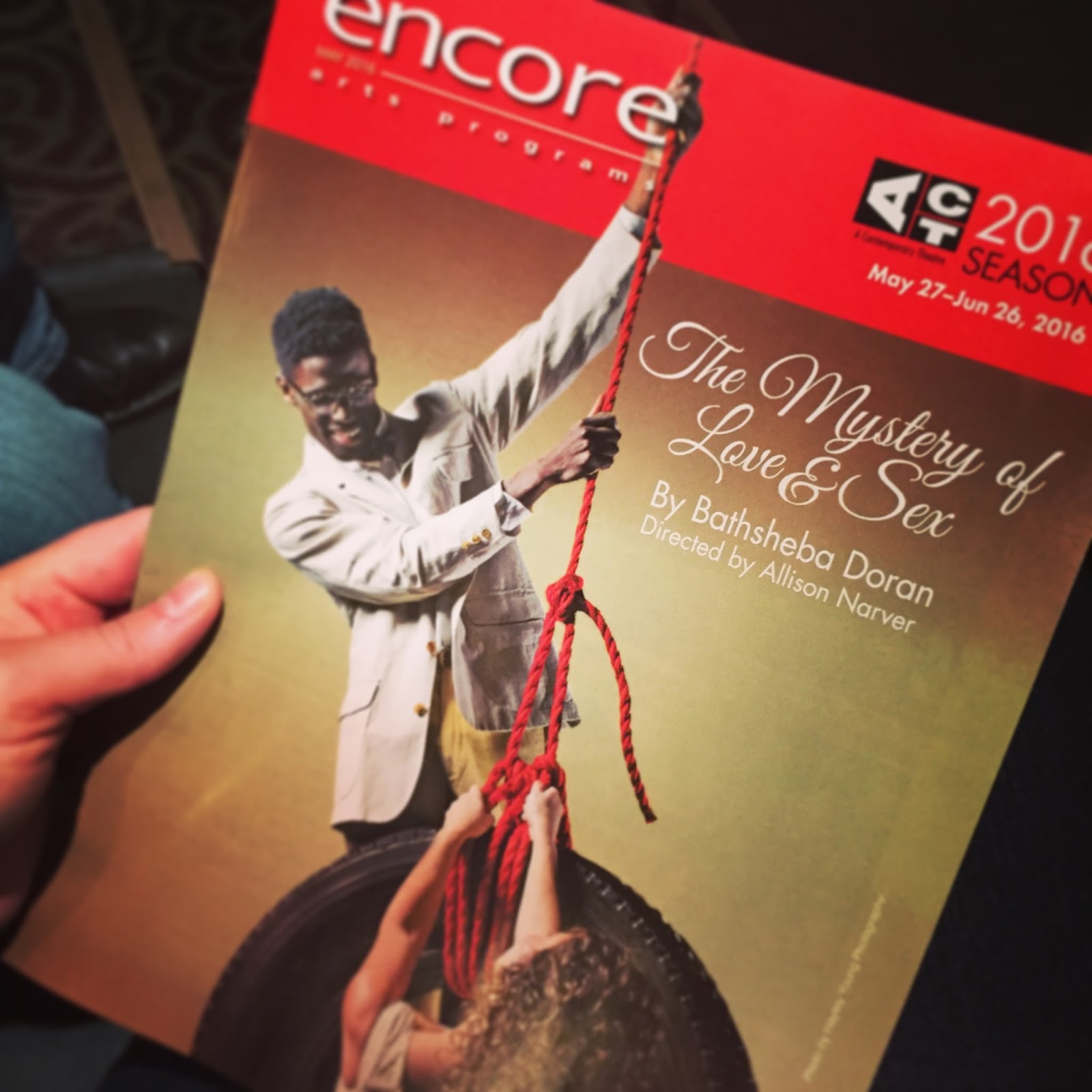
Bubblegum Part 2 : The Mystery of Love & Sex @ ACT

Time to put this idea into practice.

Show: The Mystery of Love & Sex by Bathsheba Doran
Theatre: ACT in Seattle
Tickets: ACTPass Membership
Date & Time: Sunday, June 19th @ 7pm

One of the things I've been told I need to do with these is to lay out my expectations of the show. In that vein I must divulge that I went into this show a little unsure. This was the show that was labeled "bubblegum" by a colleague a few weeks ago. I tried to go into this viewing with an open-mind, but that critique was there and to pretend it wasn't is a disservice. Keeping that in mind:

Overall, the show was good. Despite being three weeks into the run and the last night of a long week of shows, the energy of the cast was there. I was wholly impressed with the commitment to the characters on stage by the actors. I'll admit I spent an unnecessary amount of the first act trying to remember that I'd just recently seen Emily Chisholm in Outside Mullingar at The Rep last season. But I tend to obsess over things like that until I can re-read the program looking for an answer.

Since I chose to lead with the assessment of the energy of the piece, that might point to whether I, too, imagine it to be bubblegum. To be clear, the explanation of bubblegum theatre is: "Sure it has flavors of racial struggle or LGBT oppression or meta-theatrical-revolution. But then you chew on it for a couple hours, it loses all flavor, and it ends up being tossed out with the program." I found myself saying to my husband at intermission, things felt too superficial. There were so many issues being tackled by the play--race, religion, sexuality, politics, socio-economics, gender roles, etc--that no one thing felt, at that point, to be given enough attention to feel worthwhile. I still felt that way at the end of the show, my opinion countered with the observation that, well, isn't that life? Do we actually spend every waking moment dealing with one or two BIG issues or are they all converging at the same time, bouncing off of one another, and changing with every passing moment and interaction? True. And perhaps it's my cynicism, but I want theatre to gob-smack me a little bit more and not feel so nicely tied up in a bow at the end.

And here's an important thing to ask: Am I the intended audience for this play? Or is the intended audience your average person who makes their living outside of the arts and who might, in fact, not question gender and sexuality politics on a daily basis. The average person who needs to unpack their feelings about being titillated by the nudity of the young female character in Act 1 but feeling like the nudity of the young man in Act 2 is gratuitous. Maybe the average person who thinks it's unlikely that both young characters explore homosexual relationships and have no interest in exploring a heterosexual relationship with one another. Etc.

No, I'm not really the intended audience member. The goal of this production is not to wow the theatre artists in the room. If it had been the set probably wouldn't have been such a simple answer to the many locations called for in the play (6, if you're counting, ranging from dorm room to backyard). It was elegant and effective and I think quite well done, but it was, for me with my set designer hat on, a little too static (despite multiple moving pieces). If it had been about the theatre artists in the room, they probably would not have used the door sound effect that I've heard in other productions in the Allen Theatre because for some reason when an actor walks into the vom* we won't intuit they go through an imaginary door in the imaginary walls unless we hear the sound of it open and close. Really, if it had been about the theatre artists in the room, would the play have been presented at all? Or, if it had, would it have been done in a post-apocolyptic, gender-bending manner that so many theatre artists employ to inject something into your average play? Maybe. Maybe not.

So again, the play was good. I laughed. I thought some things (often quickly brought out of deep thinking by the jokes). I even teared up at the end thinking of the meaning of friendship as the bow was tied nicely around the story. However, it isn't going to stick with me long term and maybe that means it's bubblegum. Or maybe it's just a production that exists. I feel neither robbed of my evening nor galvanized to make changes in the world at large or in my small circle of relationships. I could take it or leave it.

And, readers, that's not okay.

Leaving aside my feelings about the aesthetics of the show because, let's be honest, I picked apart the Tony-winning costume design of Hamilton so clearly I'll critique anything, the play itself should move me. I'm still a person who is married; who has questioned her sexuality; who is navigating the building, destruction, and definition of friendship; who has divorced parents; who went to college; who who who who who.... I am seeking, as implied by the title, to solve the mystery of love and sex. For me to have this "take it or leave it" feeling about the play just as an audience member, well, then I, as a theatre-maker, ask: "Why?" Why spend the resources to put that show up? It checks a lot of boxes: contemporary female playwright, diverse cast (25% is black!), dealing with Big Issues of the day (LGBTQ, race, religion, gender), and strong female characters to name a few. But a production should do more then check some boxes, which, when all is said and done, is about what this play has accomplished. Perhaps that's harsh. But let me leave you with this last observation: 35-50% of the house last night was empty and a noticeable amount of people left at intermission. Ticket sales, my friends, are hard to argue with.

And now, some stats:

# of Actors: 4
# of Female Characters: 2
# of Non-white Characters: 1

# of Artistic Team Members Listed on Title Page of Program: 10
# of Female Artistic Team Members: 5
(including: Director, Costume Designer, Production Assistant, Asst. Lighting Designer, & Dialect  Coach)

---
*vom: short for vomitorium